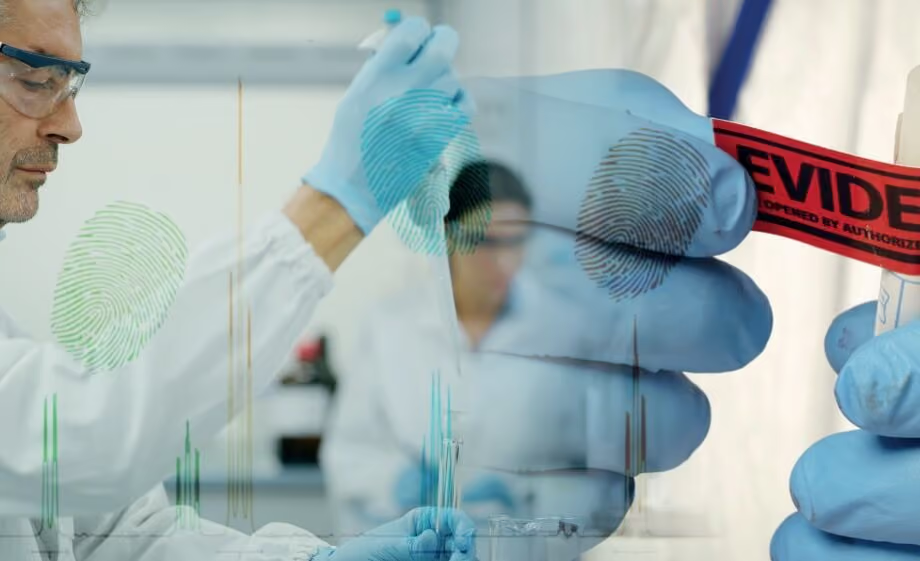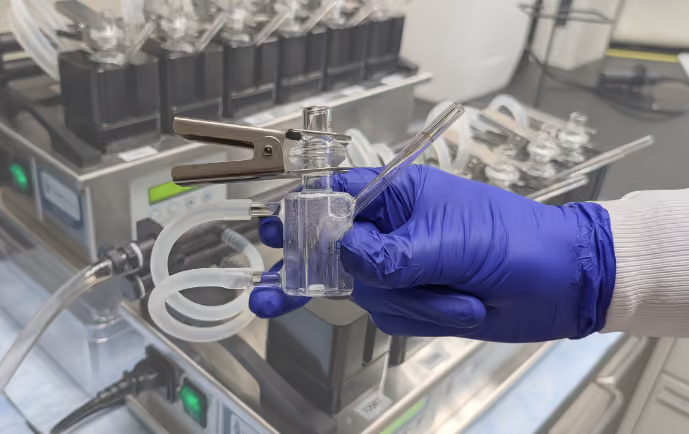
The objective of this webinar is to provide perspective on the current in vitro permeation testing (IVPT) landscape and to demonstrate how scientific rigor and creative problem-solving can address diverse industry needs when developing and evaluating dermatological products or products with potential for dermal exposure.
As complex topical products (e.g., transdermal patches and biologics), novel cosmetic ingredients, and new agrochemicals emerge, in vitro permeation testing (IVPT) has become a powerful tool spanning early discovery through preclinical and regulatory studies. Its growing adoption across industries has been further driven by global efforts to refine, reduce, and replace animal use (the 3Rs) in preclinical testing and beyond. Continuing to expand our understanding of IVPT guidance and how novel topical products and exposure scenarios can be evaluated within existing frameworks is critical.
Key Topics:
- An overview of the global guidance documents that outline requirements for successful IVPT studies.
- Trends in the application of IVPT to risk assessment, including on how going beyond current guidance can be beneficial as the complexity and novelty of topical products continues to increase.
- Strategies for adapting traditional IVPT approaches to meet evolving industry demands: including lessons learned from incorporating external stimuli, defining excised skin requirements, and strengthening IVPT conclusions through the integration of mechanistic skin modeling.
Featuring Insights from
Lauren Brown
MS, DABT
Lauren Brown is a board certified toxicologist with more than 15 years of experience supporting consumer product, cosmetic, and environmental health decision making through rigorous, evidence based science. Her consulting approach is grounded in a commitment to public health protection and the clear, defensible interpretation of complex data.
Trained at the Harvard T.H. Chan School of Public Health and experienced across government, NGOs, start ups, and Fortune 500 companies, Lauren specializes in toxicological risk assessment, ingredient and product safety evaluations, next generation risk assessment, systematic literature reviews, and the development of toxicological reference values. She has led assessments for a wide range of chemical ingredients and exposure scenarios, integrating diverse evidence streams to deliver transparent, actionable conclusions.
Before founding Applied Risk and Toxicology, Lauren served in senior scientific roles at highly respected consulting firms, where she conducted and directed risk assessments for consumer products, cosmetics, OTC ingredients, and drinking water contaminants.

Alec Salminen
PhD
Dr. Alec Salminen is Manager of In Vitro Assay Services at LifeNet Health LifeSciences. He holds a Ph.D. in Biomedical Engineering and completed post-doctoral training at the U.S. FDA’s National Center for Toxicological Research, where he evaluated alternative skin barrier models for in vitro permeation testing (IVPT). His expertise includes tissue barrier modeling, dermal absorption assessment, and custom assay development. He currently leads a team specializing in the design and execution of advanced in vitro testing platforms that support research, product development, and regulatory decision-making across a range of life science industries.
Sponsored by
LifeNet Health LifeSciences
In Partnership with
Scientist.com
Scientist.com is the world’s largest and first platform built for the intricacies of scientific outsourcing.
We help pharmaceutical and biotechnology organizations discover, engage, manage, and scale relationships with the providers that support every stage of the pipeline—from discovery and preclinical research to clinical development, manufacturing, medical affairs, and commercialization. Through a centralized platform, organizations can access a global network of 6,000+ providers, streamline sourcing and procurement workflows, maintain compliance, manage supplier relationships, and leverage data-driven insights to make faster, more informed decisions.
Today, Scientist.com supports more than 130 life science organizations, including 24 of the world's top 30 pharmaceutical companies, helping teams reduce operational complexity, accelerate timelines, and bring innovations to patients faster. Our mission is to make it possible to cure all human disease by 2050.