Many established physiologists say that their professional engagement outside the lab has profoundly affected their careers. Whether through participation in the American Physiological Society (APS) or the broader scientific community, these opportunities provide invaluable connections and skills that contribute to professional success.
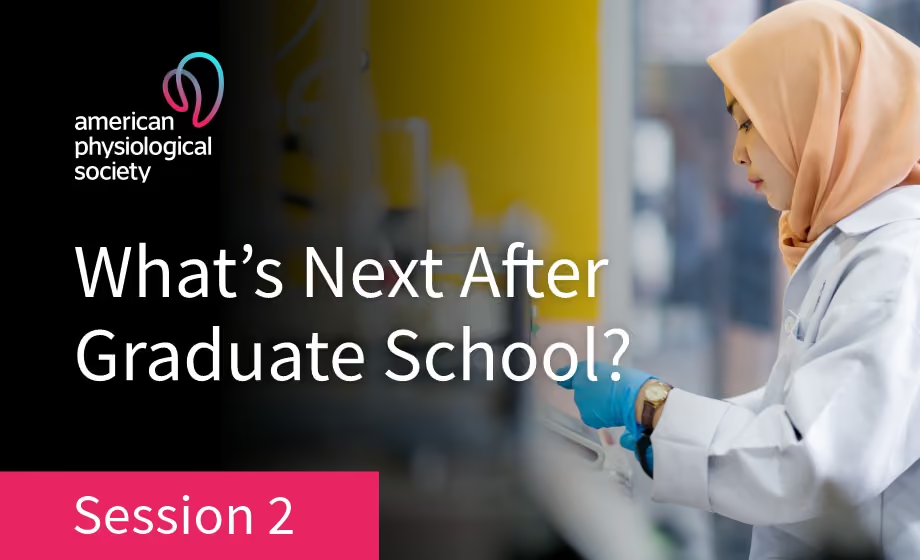
In this webinar, APS member Carmen De Miguel, MS, PhD, and APS Executive Director Scott Steen, CAE, FASAE, will give an overview about how trainees and early-career scientists can benefit from getting involved with the Society. They will discuss what emerging members of the physiology community can learn from participating in science outreach and promotion activities within their local community.
Featuring Insights from
Scott Steen
FASAE, CAE
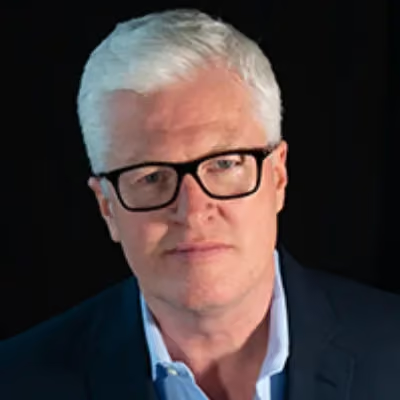
Scott Steen, CAE, FASAE, was appointed as the executive director of the American Physiological Society in July of 2018. The Society is a global leader in expanding knowledge related to biological function, championing the importance of physiology for achieving breakthroughs in health, disease and our understanding of life. Previously, Steen led two science-focused organizations: the American Ceramic Society—a science and engineering society—and, most recently, American Forests. During his tenure at both organizations, he presided over substantial increases in revenue, membership growth, innovation and member engagement. While Steen was president & CEO of American Forests, membership tripled, the organization launched several new, high-profile initiatives and operating revenue nearly doubled. The organization also received media coverage in such outlets as The New York Times, USA Today, The Washington Post, and NPR, and was named one of the best managed environmental charities in America by Outside Magazine. Steen has also served as chief strategy officer at the American Society of Association Executives (ASAE) and chief operating officer of the Center for Association Leadership, a think tank and education center for association managers and leaders. He is a Certified Association Executive (CAE), a fellow of ASAE, and a frequent author and speaker on topics that include managing organizational change, creating cultures that support innovation, storytelling as a leadership tool, branding, member engagement and future trends in association management.

Carmen De Miguel
PhD
Carmen De Miguel received her bachelor of science degree in Biochemistry and Molecular Biology from the Universidad Autónoma de Madrid in Spain, her PhD in renal physiology from the Medical College of Wisconsin, and her master’s degree in cell and molecular biology from St. Cloud State University. De Miguel is currently an assistant professor of medicine in the Division of Nephrology at the University of Alabama at Birmingham. Research in De Miguel’s laboratory is focused on understanding how immune cells and immune mediators impact renal function and end-organ damage during hypertension and diabetes. De Miguel is very active in APS and has served in several society committees. She is also passionate about science outreach and the value of social media to make science more accessible.
In Partnership with
American Physiological Society
Founded in 1887, the American Physiological Society is a global leader in expanding knowledge related to biological function. We connect a multidisciplinary community of nearly 10,000 scientists and educators from around the world, driving collaboration and spotlighting scientific discoveries in physiology and related disciplines. Our members are advancing treatments and cures for everything from cancer and heart disease, to obesity and addiction. They are also deepening our insight into living organisms generally, helping us to better understand how things like climate change are affecting the world around us.