As you approach the conclusion of your pre- or postdoctoral work, you are probably asking, "What should my next step be and how do I get there?" Two oft-mentioned career choices are "Academia" or "Industry." While both career types can be fulfilling and rewarding, it is important to realize that there are similarities and differences that you need to be aware of in order to be successful.
During this live webinar, Michelle Gumz, PhD and Carrie Northcott, PhD compare and contrast Academia and Industry careers, and discuss several key topics related to career planning and transition, including building your CV/resume, networking, crafting your online presence, and how and where to search for jobs.
Together, they provide insights and thoughts on how to not only survive but thrive as a next-generation scientist!
Featuring Insights from
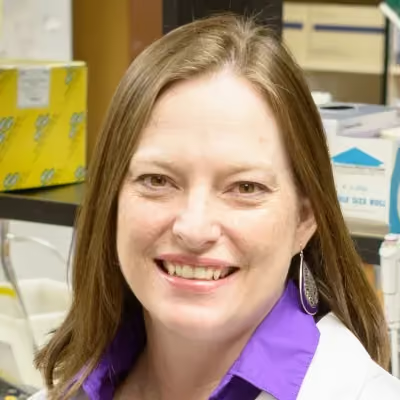
Michelle Gumz
PhD
Gumz is an associate professor of medicine at the University of Florida (UF) where she also serves as an associate director for the Center for Integrative Cardiovascular and Metabolic Disease. She earned her PhD in biochemistry and molecular biology from UF in 2004 and later joined the faculty after completing postdoctoral training in renal physiology. Gumz served four years as treasurer for the APS Renal Section and has been a member of the APS Women in Physiology and Science Policy committees. Gumz currently serves as an associate editor for the American Journal of Physiology-Renal Physiology. Gumz and her laboratory study the role of the molecular circadian clock in the kidney and its contribution to blood pressure regulation and renal function.
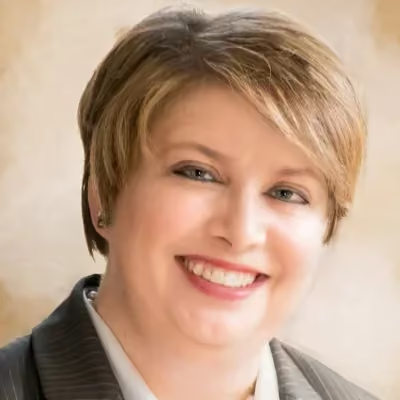
Carrie Northcott
PhD
Carrie Northcott, PhD is a director and research project lead within the Digital Medicine and Translational Imaging (DMTI) group in Early Clinical Development (ECD) at Pfizer, located in Cambridge, MA. She leads a diverse team that is evaluating and validating the use of wearable digital devices to more fully understand and characterize physiological endpoints, such as quantitatively measuring nighttime scratch and sleep. Northcott has a diverse scientific background in pharmacology, toxicology, and physiology which provides unique insight into understanding how these endpoints provide meaningful information to patients, doctors and researchers to better treat and understand diseases. Northcott received her PhD in pharmacology and toxicology from Michigan State University and her master’s and bachelor of science degrees in agricultural sciences/agronomy from the University of Illinois. She has published numerous scientific publications in various fields of scientific study and is actively involved in various scientific societies and volunteers within the community.
In Partnership with
American Physiological Society
Founded in 1887, the American Physiological Society is a global leader in expanding knowledge related to biological function. We connect a multidisciplinary community of nearly 10,000 scientists and educators from around the world, driving collaboration and spotlighting scientific discoveries in physiology and related disciplines. Our members are advancing treatments and cures for everything from cancer and heart disease, to obesity and addiction. They are also deepening our insight into living organisms generally, helping us to better understand how things like climate change are affecting the world around us.