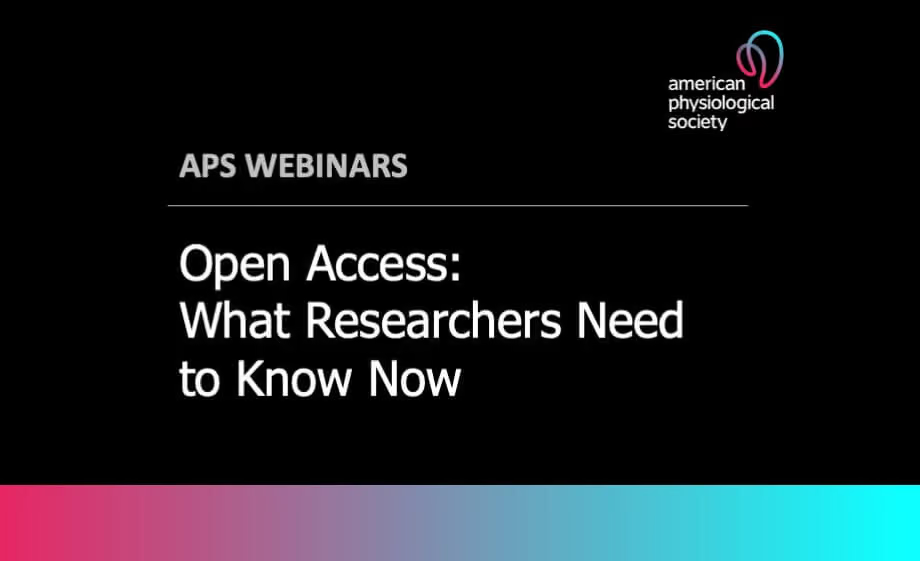
Industry professionals define what it means to publish Open Access, the different types, factors that influence funding, and share how to manage related fees from grants and budgets in several examples.
Researchers, including published authors and APS members, understand that rapid and widespread dissemination of physiological research can advance the field. Open Access (OA) publishing is frequently mentioned as a path toward this future, but what does this mean for researchers?
In this APS webinar, industry experts, Lisa Janicke Hinchliffe and Dr. Dennis Brown, will take a closer look into Open Access from the perspective of the scientist.  First, Lisa Janicke Hinchliffe, Professor for Information Literacy Services and Instruction from the University of Illinois at Urbana-Champaign, will give an overview that defines OA, outlines the different types, and the factors that drive funding. 
Following, you will hear examples form scientist who have published extensively in Open Access models to learn how they handle related fees from their grants and budgets.  And more specifically, what options are available to APS authors.  Case examples will be provided from:
- Patricia E. Molina, MD, PhD - LSUHSC New Orleans, LA
- Ole Petersen, CBE, FRS - Cardiff University
- Josephine C. Adams, PhD - University of Bristol, UK
- René J.M. Bindels, PhD - Institute for Molecular Life Sciences, Nijmegen, the Netherlands
- Alicia Schiller, PhD - University of Nebraska Medical Center
Featuring Insights from

Lisa Janicke Hinchliffe
MS
Lisa Janicke Hinchliffe is Professor and Coordinator for Information Literacy Services and Instruction in the University Library and Affiliate Professor in the School of Information Sciences at the University of Illinois at Urbana-Champaign. She is responsible for the instruction of programs for library users and professional development for library staff and faculty as well as campus outreach and collaborations related to teaching and learning. As the 2010-2011 ACRL President, she led the launch the ACRL Value of Academic Libraries Initiative. Lisa is currently Editor of Library Trends and chair of the IFLA Information Literacy Section. Lisa has consulted, presented, and published widely on the scholarly communications, publishing, the value of libraries, strategic planning, organizational innovation, emerging technologies, program evaluation, library assessment, inclusion and equity, information literacy, and teaching and learning.

Dennis Brown
PhD
Dennis Brown, PhD, joined the APS staff in July 2019 as the Society’s first-ever chief science officer (CSO). In this role, he will serve as the Society’s primary scientific spokesperson and advocate, overseeing the science policy, scientific meetings and education and member communities departments. He currently serves as professor of medicine at Harvard Medical School and director of the Massachusetts General Hospital (MGH) Program in Membrane Biology. He is also the associate director of the MGH Center for Systems Biology and director of the MGH Office for Research Career Development (ORCD). Brown has held key leadership positions at APS, including serving as the Society’s 90th president. He will split his time between APS headquarters in Rockville, Md., and Boston, where he will retain his affiliation with both Harvard and MGH.
In Partnership with
American Physiological Society
Founded in 1887, the American Physiological Society is a global leader in expanding knowledge related to biological function. We connect a multidisciplinary community of nearly 10,000 scientists and educators from around the world, driving collaboration and spotlighting scientific discoveries in physiology and related disciplines. Our members are advancing treatments and cures for everything from cancer and heart disease, to obesity and addiction. They are also deepening our insight into living organisms generally, helping us to better understand how things like climate change are affecting the world around us.