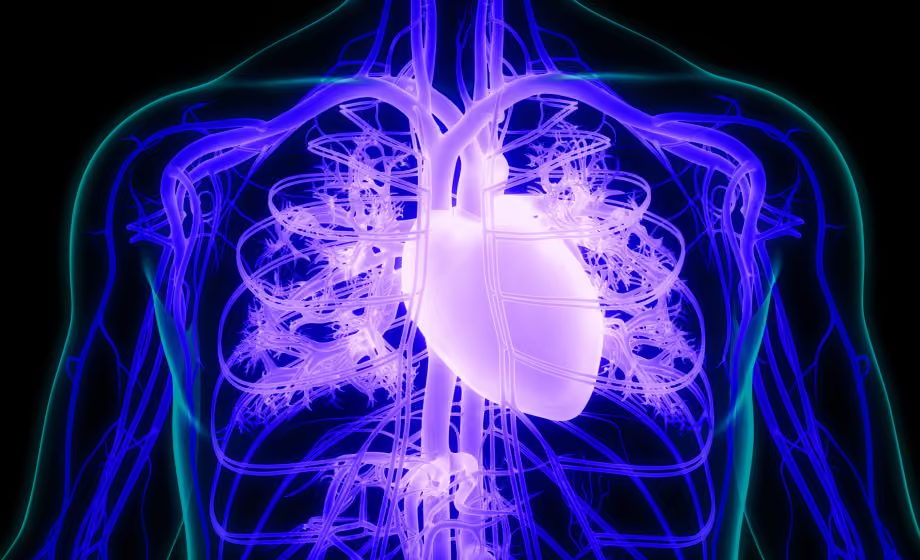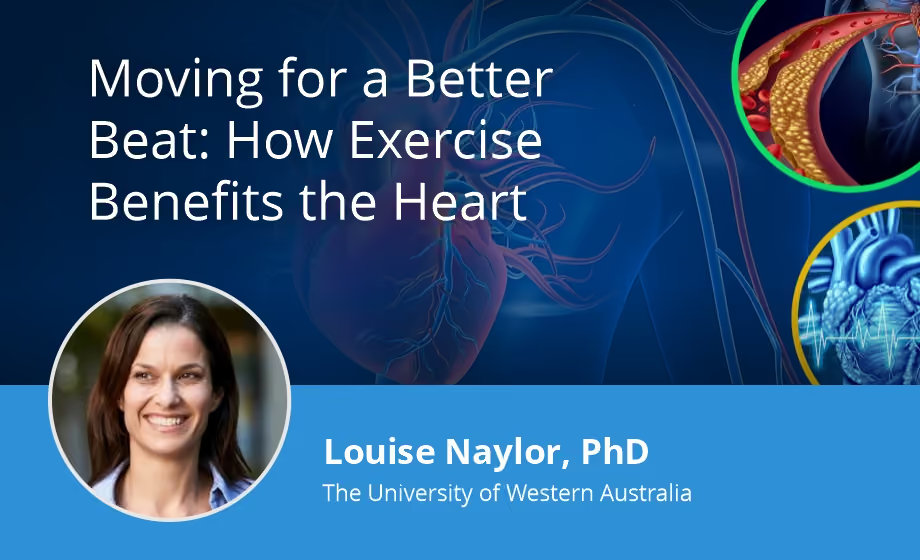
In this webinar, Professor Louise Naylor discusses the benefits of exercise in maintaining and restoring cardiovascular and overall health.
Louise Naylor, PhD, begins this webinar by discussing the effects of exercise on cardiovascular health and overall risk of mortality, and highlights a study conducted by Myers et al. in 2002. In this study, participants who experienced a range of cardiovascular predictors such as hypertension and obesity were compared based on how much they exercised per week. Individuals who performed some amount of moderate to vigorous exercise weekly were found to have a significantly lower mortality rate than those who exercised less frequently, regardless of cardiovascular precursors.
"As little as 15 minutes of physical activity each day is associated with a 14% reduction in all-cause mortality."
The Physical Activity Guidelines for Americans recommends a minimum of 150 minutes of moderate exercise per week, such as walking, jogging, or swimming. While it is widely accepted that exercise is beneficial for health, is it possible to exercise too much? One study found that individuals who far exceeded the recommended amount of weekly exercise had a slight increase in mortality risk. Excessive exercise can cause an increase in blood markers associated with cardiomyocyte injury, cardiac fatigue, and could lead to fibrosis if recovery is inadequate. These changes in cardiac function are likely a protective adaptation in response to vigorous exercise, however the mechanism behind these changes has yet to be fully understood. 
"Exercise is the closest thing we have to a magic bullet"
Most researchers agree that the benefits of exercise far outweigh the risks. However, not all exercise is created equal, and different kinds of exercise may impact people differently. Overall, athletes have been found to have an increased left ventricular mass, but the pattern of left ventricular hypertrophy varies among types of physical activity. For example, athletes who perform more resistance-based training (e.g., weight lifting) tend to have thicker ventricular walls, resulting in concentric hypertrophy, while those who perform mainly endurance-based activities (e.g., running) tend to have increased ventricular cavity size but normal wall thickness, a phenomenon known as the Morganroth hypothesis. However, these athletes were all Olympians and little scaling was done to correlate with their body mass.
To observe whether these changes in left ventricular mass were a result of the athletes' fitness levels and if they could be induced by exercise in non-athletes, Professor Naylor and colleagues subjected participants to either endurance or resistance training, allowed them to rest for several weeks, and then swapped their training method. While endurance training could induce eccentric hypertrophy, limited hypertrophy was observed with resistance training, casting some doubt on the Morganroth hypothesis.
"If you start exercising and you're not [seeing the results] you hoped for, you might be able to switch up your routine to get those benefits."
In a follow-up study, sets of twins performed either endurance or resistance training for three months, after which they returned to baseline and swapped the type of exercise. Similarly to the results of the previous study, endurance and resistance training resulted in increased and decreased left ventricular mass, respectively, further disproving the Morganroth hypothesis. 
In the final portion of this webinar, Professor Naylor examines two case studies of individuals who struggled to regain physical activity after a cardiovascular event. The first case study involved a patient with a history of heart failure that required prolonged bed rest; eccentric exercise (i.e., low cardiorespiratory demand) greatly improved their strength and allowed them to return to normal physical activity. In the second case study, Professor Naylor found that exercise games (e.g., Just Dance) were effective in improving physical activity following heart failure. Professor Naylor concludes that although integrating exercise into daily routines can be a daunting challenge, many benefits will soon follow.
Webinar Highlights
- Develop a deeper appreciation of the importance of exercise to optimize and maintain cardiovascular health
- Appreciate that all exercise isn't all the same - different modes of exercise induce distinctly different physiological stimuli and adaptation
- Understand whether exercise is safe for everyone
- The Goldilocks Principle: is there such a thing as too little or too much exercise?
- Not everyone responds the same to an identical exercise program
Featuring Insights from

Louise Naylor
PhD
Dr. Naylor's research focus is on cardiovascular adaptations to exercise training, and application of this work to optimize clinical outcomes across the life span. Her work also spans the spectrum of health and disease, from elite athletes to chronically ill individuals creating a multifaceted understanding of cardiovascular physiology.
In Partnership with
American Physiological Society
Founded in 1887, the American Physiological Society is a global leader in expanding knowledge related to biological function. We connect a multidisciplinary community of nearly 10,000 scientists and educators from around the world, driving collaboration and spotlighting scientific discoveries in physiology and related disciplines. Our members are advancing treatments and cures for everything from cancer and heart disease, to obesity and addiction. They are also deepening our insight into living organisms generally, helping us to better understand how things like climate change are affecting the world around us.
European Council for Cardiovascular Research
The history of the European Council for Cardiovascular Research (ECCR) goes back more than 30 years when the ‘European Blood Pressure Group’ held its first meeting in March 1979 in Cambridge, UK. To date more than 30 international meetings have been held in various European locations. For more information about ECCR history click here.
The mission of ECCR is to promote prevention, diagnosis and treatment of disease and the preservation and protection of good health through experimental and clinical research in hypertension, cardiovascular and metabolic disease.
ECCR holds an Annual Meeting in October. The purpose of these scientific meetings is to provide a forum for active clinical and non-clinical researchers to discuss important aspects of their work, to advance and strengthen European research in the field of cardiovascular disease, high blood pressure and cardiometabolic disease. The meetings bring together both senior and junior scientists from the leading European groups in the field of cardiovascular research.
ECCR is a member of the Council for Basic Cardiovascular Science (CBCS) of the European Society of Cardiology (ESC), whose aims are to enhance the importance of basic science to clinical cardiology and act as a Europe wide forum for cardiovascular research societies, and a conduit for positive collaboration.