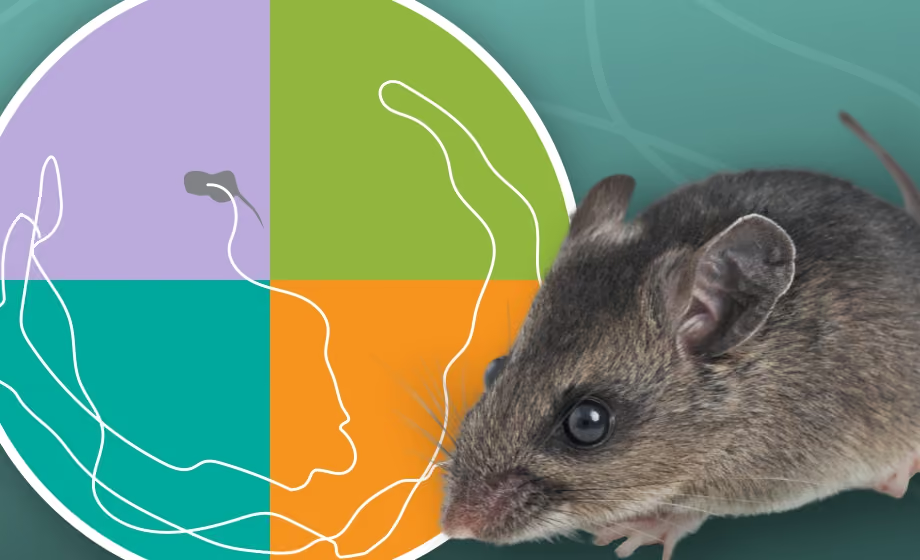
Anatomy and physiology (A&P) and general biology are traditionally taught in separate portions of a biology curriculum, and introductory A&P courses often lack an evolutionary biology emphasis. Penn State has developed a Plant and Animal Biology course taken by first- and second-year undergraduate biology majors that integrates plant and animal biology around common themes, such as physical support, gas exchange, and energy acquisition, with an emphasis on anatomy & physiology. Students study how plants and animals evolved solutions to shared challenges such as the transition to land and maintaining homeostasis in a terrestrial environment. Many of these solutions are surprisingly similar despite co-evolving separately. Other mechanisms can be traced back to the last eukaryotic common ancestor that gave rise to plants and animals. Their goal is to help students organize their understanding of biology around larger themes common across the life sciences, and to see plants and animals (including humans), not as unrelated entities relegated to artificial boxes within a curriculum, but as evolutionary cousins in a diverse family of intimately related organisms.
Featuring Insights from

John R. Waters
PhD
John Waters is a professor in Penn State's Biology Department who has taught undergraduate courses in anatomy & physiology, general biology, the history of anatomy, and pedagogy over the last twenty-eight years. In addition to teaching, John is interested in identifying effective teaching methods for lecture and laboratory settings, and enjoys collaborating with colleagues and students in Penn State's Department of Educational Psychology who are interested in conducting research in biology education.
John is a member of the American Association of Anatomists (AAA) and is a member and president emeritus of the Human Anatomy and Physiology Socieity (HAPS). At Penn State, John currently serves as the Biology Associate Department Head for Undergraduate Education.
Sponsored by
ADInstruments
In Partnership with
Human Anatomy & Physiology Society
GOALS:
- To enhance the quality of human anatomy and physiology instruction at colleges, universities, and related institutions.
- To promote and facilitate communication and collaboration among teachers of human anatomy and physiology.
- To encourage innovation, educational research, and publication by human anatomy and physiology teachers.
- To promote and organize professional development programs for the teaching of human anatomy and physiology.
- To promote interaction among science teachers at all educational levels.
- To provide the membership with opportunities to become and remain informed about the latest developments in the health/science field.
- To facilitate communication with other sectors of the educational and scientific community and to collect and disseminate to the membership information regarding events of interest.
- To foster a sense of collegiality and camaraderie among members.
Some of the members-only resources include:
-
A discussion group that has evolved from the legendary HAPS listserv (HAPS-L) that has the most interesting conversations in A&P. Have a question? Chances are that it will be answered within hours. Have a really hard question? Chances are it will get 20 replies by the end of the day. Many of the top authors in A&P are active participants, as are many of the top instructors in the country.
-
An inclusive leadership that promotes member participation and growth. You don't have to be a HAPS member for decades to join committees and move into leadership positions.
-
Immediate access to new editions of the peer-reviewed HAPS-EDucator, which is published online three times per year. Articles cover various topics important to A&P instructors.
-
Online access to Anatomical Sciences Education (ASE), a Medline-indexed journal that publishes articles related to all levels of anatomical sciences education including undergraduate, allied health, medical (both allopathic and osteopathic), dental, graduate and post-graduate programs, and covers the major disciplines of the anatomical sciences
-
Reduced tuition for HAPS Institute (HAPS-I) courses. Courses can either earn graduate-level credit or professional development certificates. Courses are primarily all online and offer flexibility for busy professional instructors to fit the courses into their schedules. Take a look at the currently available courses here
-
Access to a huge array of nationally respected teaching resources. Take a look here.
-
A set of comprehensive safety guidelines that is continually updated.
-
A growing catalog of guided inquiry activities for teaching A&P for members only.
-
A members-only data sharing program to provide a large, curated dataset for teaching labs and classroom analysis.
-
Comprehensive catalog Learning Outcomes available to members
-
Access to the Histology Challenge - biweekly histology slides and discussion. Nearly 100 previous challenges available - many use these to sharpen their own skills and also for student assignments.
-
Grants and scholarships for travel and research available to members only. We want you to join and come to conferences, and we help those in our community who need help to make it happen.
-
Cadaver lab tours and lab reconstruction advice (both in webpages and from HAPS members if you ask...)
HAPS also works to make teaching better with:
-
Extensive work on clarifying faculty accreditation issues, including a set of tools for faculty and institutions to use to help clarify instructor qualifications.
-
Nationally respected Position Statements on Animal Use, Cadaver Use, and Distance Education. Take a look all of them here.
-
More than a decade of work producing the HAPS Comprehensive Exam. A fully online exam used both in the US and Internationally to characterize Instructors, Programs, and individual students.
-
Updated Learning Goals for Undergraduate instruction in all content areas in anatomy and physiology
-
A weekly curated set of links relevant news for 9 interest areas of A&P instruction known as Whats New in A&P that is used in classrooms across the country.
-
An active social media presence on Facebook, Twitter, and Google+ (see the links in the upper right corner of this page) to keep in touch with members and the wider community.
-
Check out HAPSblog for longer term discussions like Erin's year teaching A&P in a Houston high school or Wendy's amazing series on flipping her classroom one week at a time.