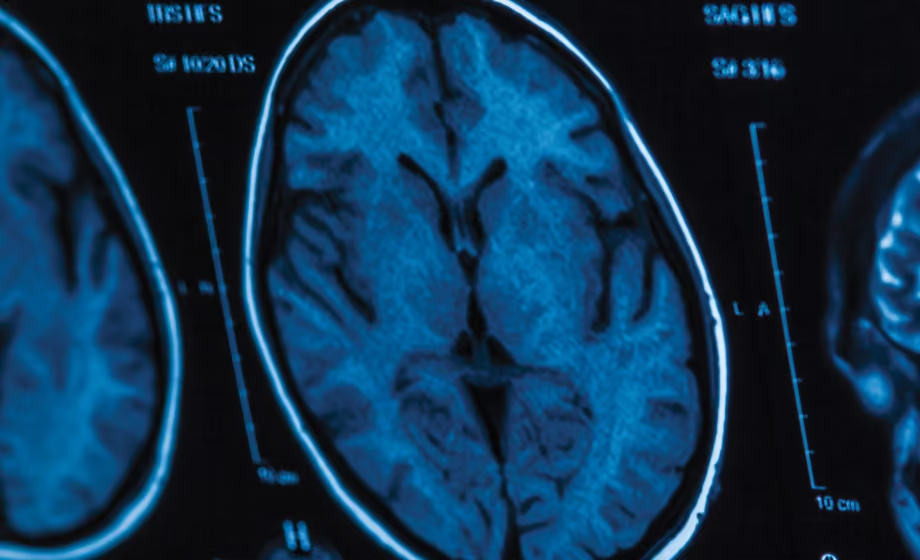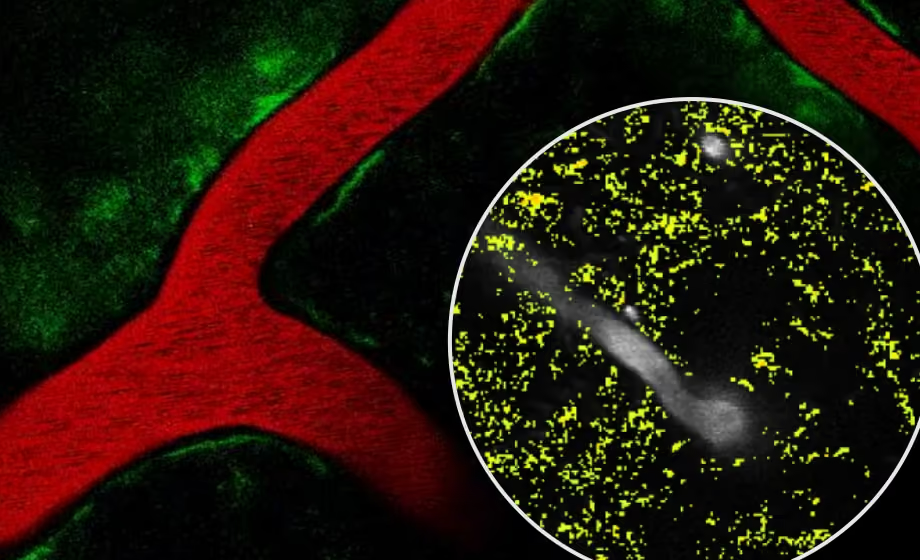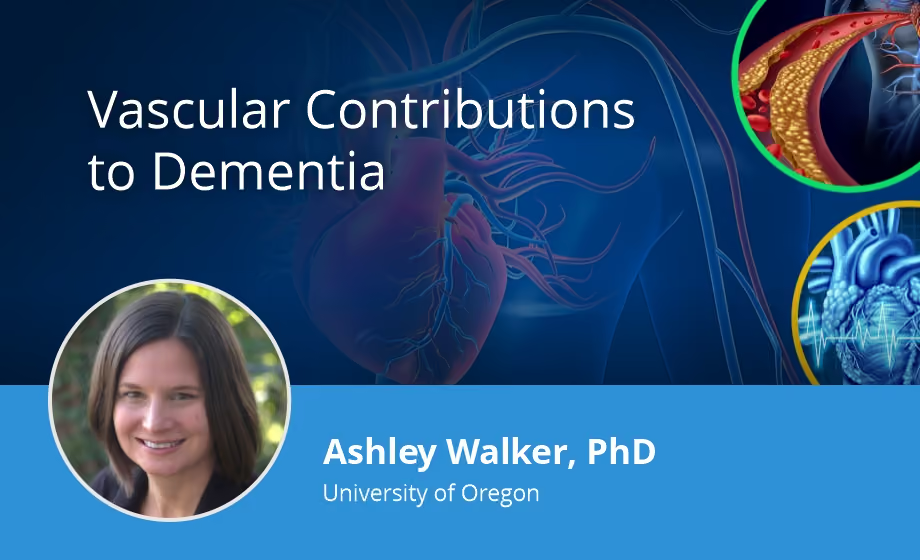
In this webinar, Professor Ashley Walker discusses the vascular contributions to dementia and the role of age-related arterial stiffness on Alzheimer's development.
Professor Walker begins this webinar with a broad overview of Alzheimer's disease and its pathology. Alzheimer's disease symptoms, such as memory impairments, challenges in problem solving, and general confusion, typically begin to appear in individuals long after disease onset. Amyloid plaques and neurofibrillary tangles are commonly observed in patients with Alzheimer's disease.
"Every 65 seconds, somebody in the United States develops Alzheimer's disease." 
Despite the high prevalence of Alzheimer's disease, large knowledge and research gaps remain. Professor Walker is particularly interested in the vascular contributions to Alzheimer's disease, since a clear link has been found between this disease and the cardiovascular system. One study that investigated multiple brain pathologies in dementia found that vascular biomarkers are the first to change, suggesting that vascular changes could be an initiating factor in Alzheimer's disease.
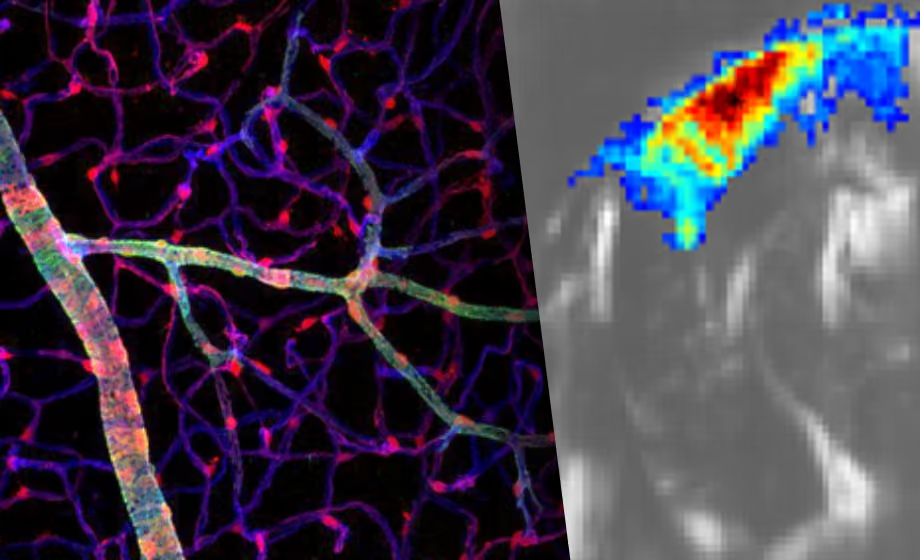
While the cardiovascular system mediates the delivery of nutrients and removal of waste for many tissues, the endothelial cells that line the arteries have the greatest impact in neurovascular function. Endothelial cells tightly regulate exchanges between blood vessels and surrounding tissues, and also mediate blood availability within the brain, directing blood flow to active neurons in a process known as neurovascular coupling. To regulate blood flow these cells must be able to constrict and dilate easily, which becomes increasingly difficult with age. Endothelial dysfunction can have many negative effects on the neurovascular system, including oxidative stress, impaired blood flow and neurovascular coupling, and a leaky blood brain barrier, which can all lead to memory problems.
Old age and cardiovascular diseases are two of the major risk factors associated with Alzheimer's disease, but what is it about aging arteries that results in dementia? In large arteries like the aorta and the carotid artery, thin sheets of rubber known as elastic lamina line the arterial walls, allowing them to stretch, recoil, and dampen any high pulse pressure that may occur. However, smaller arteries such as the cerebral artery have fewer elastic lamina than their larger counterparts, and are far less equipped to deal with high pulse pressure.
One study conducted by Professor Walker's group found that these higher pulse pressures affect younger arteries more, suggesting that this stiffening mechanism has evolved to protect against strenuous pulses. However the stiffening of the arterial wall serves as a double-edged sword, as this pushes high-intensity pulses further into smaller arteries that are less equipped to handle these pressures. Loss of elasticity can be directly linked to endothelial dysfunction; in another study, Professor Walker's group observed similar reductions in vasodilation in old mice and mice with isolated large artery stiffening. This mouse model tends to have greater oxidative stress than wild type mice, resulting in additional endothelial dysfunction and reduced vasodilation. 
"Two-thirds of the patients with Alzheimer's disease are women." 
While much research has been done on the effects and underlying mechanisms of Alzheimer's disease, further evidence is needed to determine if there are sex differences. Professor Walker notes that higher rates of arterial stiffness and cerebral flow pulsatility are observed in women compared to men, and hopes to determine the effects of sex-specific hormones on the development of Alzheimer's disease.
Webinar Highlights
- A broad overview of the vascular contributions to Alzheimer's disease
- Effect of endothelial dysfunction on the neurovascular system
- Role of age related arterial stiffness in Alzheimer's development
Featuring Insights from

Ashley Walker
PhD
Ashley Walker’s research seeks to determine the causes of vascular dysfunction with advancing age and the consequences of these impairments. A focus of current her research is to understand the effects of age-related increases in arterial stiffness on cognitive decline and Alzheimer’s disease pathology.
In Partnership with
American Physiological Society
Founded in 1887, the American Physiological Society is a global leader in expanding knowledge related to biological function. We connect a multidisciplinary community of nearly 10,000 scientists and educators from around the world, driving collaboration and spotlighting scientific discoveries in physiology and related disciplines. Our members are advancing treatments and cures for everything from cancer and heart disease, to obesity and addiction. They are also deepening our insight into living organisms generally, helping us to better understand how things like climate change are affecting the world around us.
European Council for Cardiovascular Research
The history of the European Council for Cardiovascular Research (ECCR) goes back more than 30 years when the ‘European Blood Pressure Group’ held its first meeting in March 1979 in Cambridge, UK. To date more than 30 international meetings have been held in various European locations. For more information about ECCR history click here.
The mission of ECCR is to promote prevention, diagnosis and treatment of disease and the preservation and protection of good health through experimental and clinical research in hypertension, cardiovascular and metabolic disease.
ECCR holds an Annual Meeting in October. The purpose of these scientific meetings is to provide a forum for active clinical and non-clinical researchers to discuss important aspects of their work, to advance and strengthen European research in the field of cardiovascular disease, high blood pressure and cardiometabolic disease. The meetings bring together both senior and junior scientists from the leading European groups in the field of cardiovascular research.
ECCR is a member of the Council for Basic Cardiovascular Science (CBCS) of the European Society of Cardiology (ESC), whose aims are to enhance the importance of basic science to clinical cardiology and act as a Europe wide forum for cardiovascular research societies, and a conduit for positive collaboration.