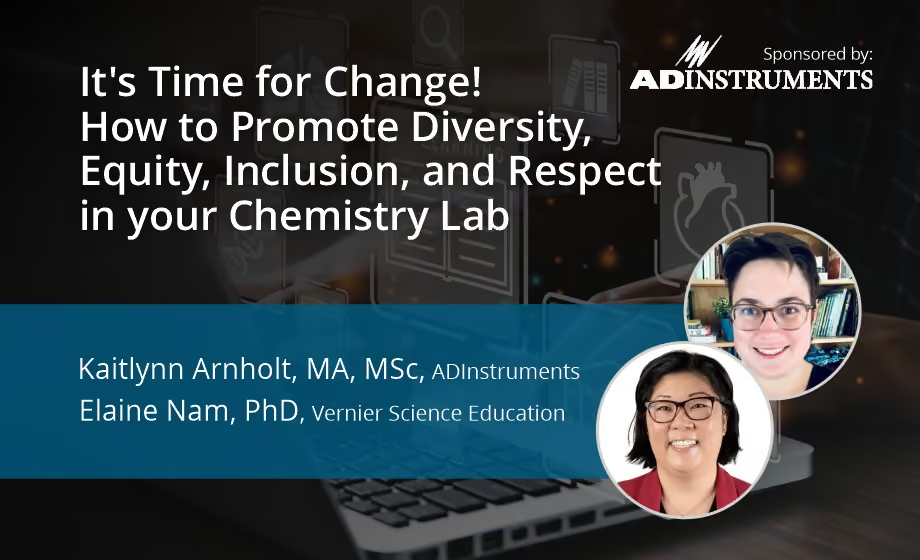
In this webinar, Professor Wendy Riggs delves into the importance of building a community in an online classroom, common barriers to this process, and solutions to overcome these obstacles.
Professor Riggs begins this webinar by addressing the difficulties students and educators have faced during the transition to online learning over the past two years. Having a sense of community is important in education; for example, a 2016 study reported that leveraging similarity to improve teacher-student relationships also improves academic outcomes. However, community tends to develop more intuitively in face-to-face settings than in an online environment.
"Online community is totally possible and it relies on shared interest. … Online communities that are robust and actually work are founded in respect."
Having a sense of community in the classroom is as important to education as the content delivery itself. Qualities of a sense of community include feeling similarities between one another, as well as having care and concern for each other, which can be facilitated remotely. Successfully creating an online community must also be intentional, and it involves inviting students into the classroom. Professor Riggs stresses that students cannot be forced to form a meaningful, authentic community, which she knows from experience.
Ineffective technologies such as poor internet connection and faulty hardware are a common barrier to building online communities that cannot be ignored. Professor Riggs also explains that it is critical to establish healthy boundaries around the time that is invested in creating a classroom community; when boundaries are not clearly defined or respected, the task can feel more overwhelming.
"As educators and especially as post-COVID educators, the conversation about boundaries is often really muddy, and it's because we have responded … in emergency mode to support our students and … each other."
In the next portion of this webinar, Professor Riggs defines ways that educators can build an online community. To facilitate a meaningful community online, educators must trust their students, recognize that they are real people behind the webcam, and help and "pester" their students. Professor Riggs recognizes the challenges of trusting students, and that educators might even be unaware that they do not trust their students until they begin to actively think about it.
"I don't think that's easy, and I think it's a huge transition in how we look at our students and look at our jobs as educators. But if you try trusting them and listening to them, it's kind of an amazing experience."
Professor Riggs believes that actively helping students achieve their goals is a powerful method for building community, as it shows them that their educator is on their side. The most unintuitive method in community building for Professor Riggs has been the idea of "pestering" students, which she learned by participating in a webinar series dedicated to equity in online teaching. Having reminders for the students or regular check-ins can be a kindness to them, and it also demonstrates to them that their instructor cares about their academic success. Professor Riggs' last advice for building an online community is to love the students, which she acknowledges can be uncomfortable; however, this can mean a lot when it comes to forming connections.
"I have notes jotted down for who [my students] are and what they're going through, and I remember that and then I go, "Look what else they're doing on top of all these other things: they're here in my class." So yeah, I gotta throw down some love for that. I do love that, and I want them to know that."
In the last portion of the webinar, Professor Riggs summarizes ten humanizing strategies for effective online teaching, which are also available as a handout in the webinar resources. The first strategy is to identify why students are in the class as well as what might make it difficult for them to be successful. Introductory discussions allow educators to get to know their students, and also allow the students to discover similarities between one another. Professor Riggs also advises instructors to keep a fact sheet about their students, as knowing things about them can help them feel more heard. Facilitating group work is also a powerful humanizing strategy that often requires little from the instructor themselves, since the students can create connections independently.
Some humanizing strategies that relate to the previously described foundational principles of community building include making videos, having a liquid syllabus, and holding weekly check-ins. Professor Riggs advises educators to be authentic and real with their students, since this gives them permission to be authentic and real in return. Pestering is also built in through the weekly check-in; Professor Riggs offers her students the opportunity to connect with her weekly through a chat or Zoom call, or by recording a video. Additionally, "liking" their discussion comments is an easy way to connect with students and give them direct feedback.
Professor Riggs has also recently transitioned to using flexible "best by" dates instead of deadlines for assignments which eliminates late work entirely. It does benefit the student to follow these guidelines since they can get more immediate feedback on their work and they can stay on track with the rest of their classmates; however, if something else comes up in their lives, they do not need to ask for an extension or worry about late penalties. Professor Riggs explains that this strategy is set up to support students when things get hard.
"It's very sobering to think about the things that they're going through and yet they're still making it happen."
The last strategy Professor Riggs shares is being clear with communication policies, which also relates to boundaries. Having clear communication policies and expectations can allow educators to be more available to their students. Professor Riggs concludes this webinar with additional resources that educators can explore to guide them through creating community.
Webinar Highlights
- Importance of community in learning
- Common barriers to fostering a sense of community online
- How to build an effective and meaningful online community
- Humanizing strategies for teaching online
Featuring Insights from

Wendy Riggs
MS
Wendy Riggs is an Associate Professor of Biology at College of the Redwoods in northern California. She has a strong background in online education and uses technology to facilitate meaningful learning opportunities for her students. She served as the President of the Human Anatomy and Physiology Society (HAPS) in 2020-21.
Sponsored by

ADInstruments
In Partnership with
Human Anatomy & Physiology Society
GOALS:
- To enhance the quality of human anatomy and physiology instruction at colleges, universities, and related institutions.
- To promote and facilitate communication and collaboration among teachers of human anatomy and physiology.
- To encourage innovation, educational research, and publication by human anatomy and physiology teachers.
- To promote and organize professional development programs for the teaching of human anatomy and physiology.
- To promote interaction among science teachers at all educational levels.
- To provide the membership with opportunities to become and remain informed about the latest developments in the health/science field.
- To facilitate communication with other sectors of the educational and scientific community and to collect and disseminate to the membership information regarding events of interest.
- To foster a sense of collegiality and camaraderie among members.
Some of the members-only resources include:
-
A discussion group that has evolved from the legendary HAPS listserv (HAPS-L) that has the most interesting conversations in A&P. Have a question? Chances are that it will be answered within hours. Have a really hard question? Chances are it will get 20 replies by the end of the day. Many of the top authors in A&P are active participants, as are many of the top instructors in the country.
-
An inclusive leadership that promotes member participation and growth. You don't have to be a HAPS member for decades to join committees and move into leadership positions.
-
Immediate access to new editions of the peer-reviewed HAPS-EDucator, which is published online three times per year. Articles cover various topics important to A&P instructors.
-
Online access to Anatomical Sciences Education (ASE), a Medline-indexed journal that publishes articles related to all levels of anatomical sciences education including undergraduate, allied health, medical (both allopathic and osteopathic), dental, graduate and post-graduate programs, and covers the major disciplines of the anatomical sciences
-
Reduced tuition for HAPS Institute (HAPS-I) courses. Courses can either earn graduate-level credit or professional development certificates. Courses are primarily all online and offer flexibility for busy professional instructors to fit the courses into their schedules. Take a look at the currently available courses here
-
Access to a huge array of nationally respected teaching resources. Take a look here.
-
A set of comprehensive safety guidelines that is continually updated.
-
A growing catalog of guided inquiry activities for teaching A&P for members only.
-
A members-only data sharing program to provide a large, curated dataset for teaching labs and classroom analysis.
-
Comprehensive catalog Learning Outcomes available to members
-
Access to the Histology Challenge - biweekly histology slides and discussion. Nearly 100 previous challenges available - many use these to sharpen their own skills and also for student assignments.
-
Grants and scholarships for travel and research available to members only. We want you to join and come to conferences, and we help those in our community who need help to make it happen.
-
Cadaver lab tours and lab reconstruction advice (both in webpages and from HAPS members if you ask...)
HAPS also works to make teaching better with:
-
Extensive work on clarifying faculty accreditation issues, including a set of tools for faculty and institutions to use to help clarify instructor qualifications.
-
Nationally respected Position Statements on Animal Use, Cadaver Use, and Distance Education. Take a look all of them here.
-
More than a decade of work producing the HAPS Comprehensive Exam. A fully online exam used both in the US and Internationally to characterize Instructors, Programs, and individual students.
-
Updated Learning Goals for Undergraduate instruction in all content areas in anatomy and physiology
-
A weekly curated set of links relevant news for 9 interest areas of A&P instruction known as Whats New in A&P that is used in classrooms across the country.
-
An active social media presence on Facebook, Twitter, and Google+ (see the links in the upper right corner of this page) to keep in touch with members and the wider community.
-
Check out HAPSblog for longer term discussions like Erin's year teaching A&P in a Houston high school or Wendy's amazing series on flipping her classroom one week at a time.