Those interested in the evolution of humankind, from "Lucy" via Neadertals towards modern humans, dogs, wolves and fossil canids, current or interested micro- and nano- CT researchers, and those interested in the ear and its functions.  More specifically: palaeontologists, archaeologists, anthropologists, biologists...
Webinar Summary
- The use of MicroCT and NanoCT in fossil ear regionexamination
- Differentiation of Neandertals from modern humans
- Separation of wolves from dogs
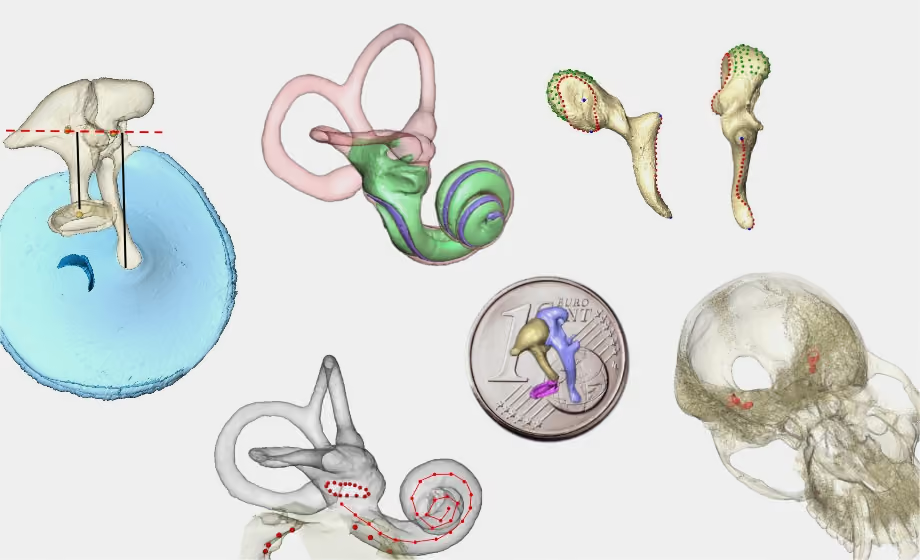
The inner ear is a highly complex organ that has evolved over aeons. Even juveniles obtain a fully developed ear region often even before birth.  While the primary function of the ear is hearing, it also provides balance, and these are just a few of its functions. Luckily, the ear region can be used to obtain insights into taxonomy/phylogeny as it is often preserved in lithified records. Thus, the ear is a perfect remnant to study fossils and extant mammals, including humans and their ancestors like Neandertals, to gain more understanding on their evolution.
During this webinar, Dr. Stößel from the Max-Plank-Institute for Human History (Jena, Germany) presents the use of micro- and nano-CT to make distinctions between wolves, dogs and fossil canids. Furthermore, micro- and nano-CT derived results allow differentiation of modern humans from Neandertals, as well as insights about Neandertal's hearing and vocal communication.
Featuring Insights from
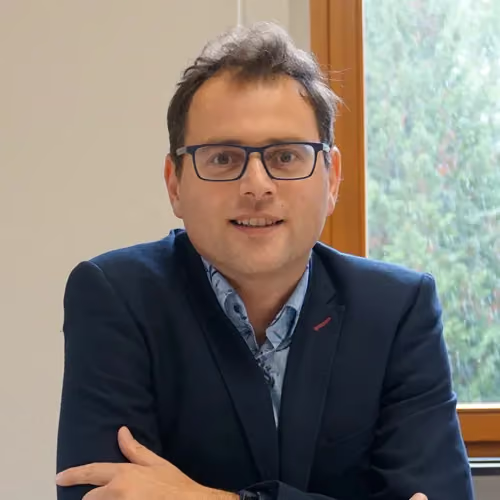
Alexander Stößel
PhD
Dr. Alexander Stößel received his PhD in Biology from Friedrich Schiller University Jena in 2011. After completing his postdoc at the Department of Human Evolution of the Max Planck Institute of Evolutionary Anthropology in Leipzig (Germany), Alexander started working on evolution of the human ear region as an Assistant Professor at the Institute of Zoology and Evolutionary Research, Friedrich Schiller University Jena (FSU). Dr. Alexander Stößel is currently the Head of the Digital Anthropology group at the Department of Archaeogenetics (Max Planck Institute for the Science of Human History, Jena (MPI-SHH).
Sponsored by