Join Ole Petersen, Roop Mallik and Erwin Neher as they share the latest research looking at endocytosis and calcium signaling in the context of SARS-CoV-2, organelle transport and calcium imaging.
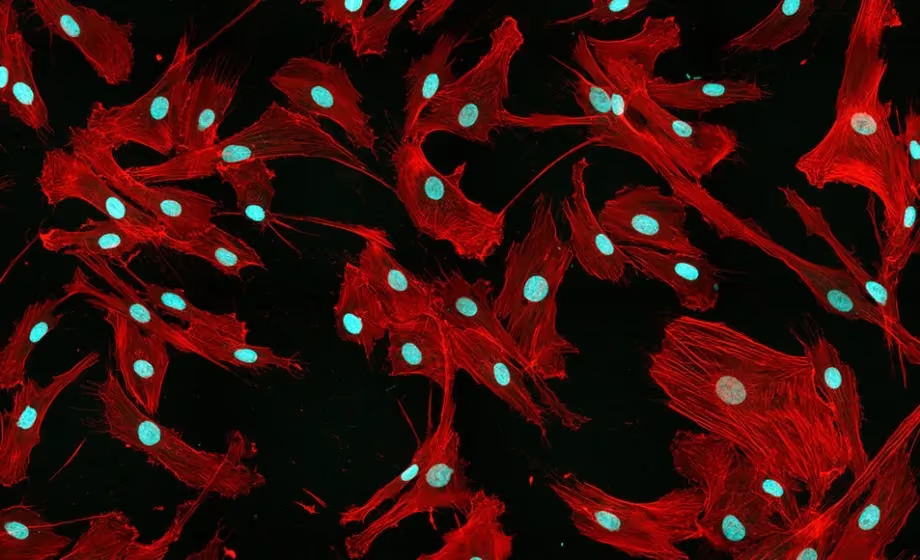
In this webinar sponsored by Function, the American Physiological Society's new broad-spectrum open-access journal, experts will discuss how the COVID-19 virus uses receptor-mediated endocytosis to gain entry into host cells, how motor proteins guide endosomes and phagosomes from the cell surface to lysosomes, and how intracellular calcium buffering can be used to modulate cell signaling and calcium imaging.
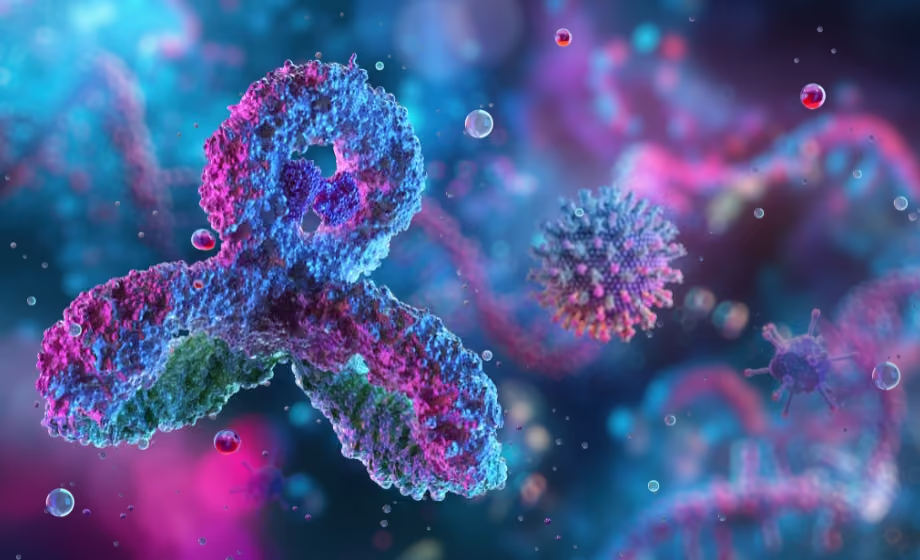
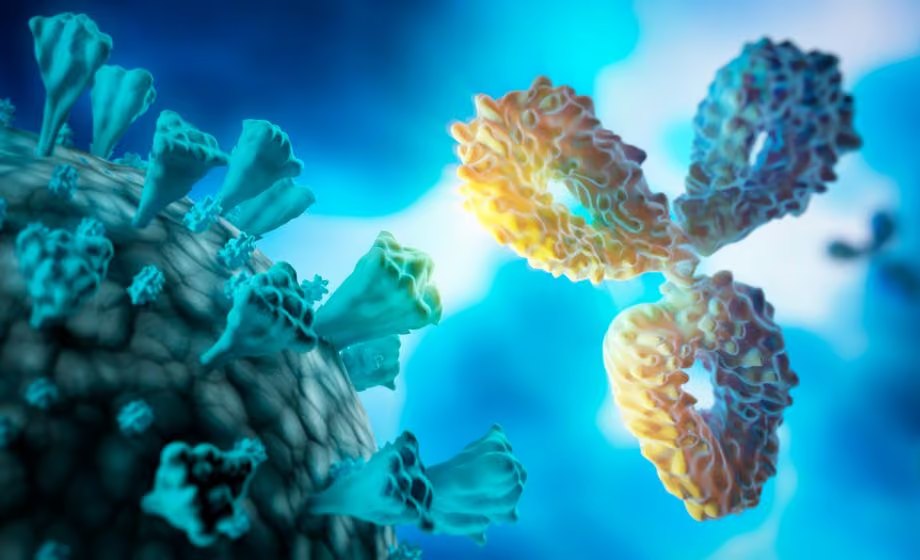
Endocytic Uptake of SARS-CoV-2: The Critical Roles of pH, Ca2+ and NAADPOle Petersen, CBE, FRSVery recent work shows that SARS-CoV-2 enters our cells through receptor-mediated endocytosis, dependent on an endosomal bafilomycin-sensitive proton pump as well as two-pore channels (TPCs). Physiological intracellular Ca2+ signals, mediated by the messenger nicotinic acid adenine dinucleotide phosphate (NAADP), depend on the very same proton pump and TPCs. Two hitherto completely separate research fields, namely molecular virology and cellular Ca2+ signaling physiology are now coming together, creating exciting new research opportunities.
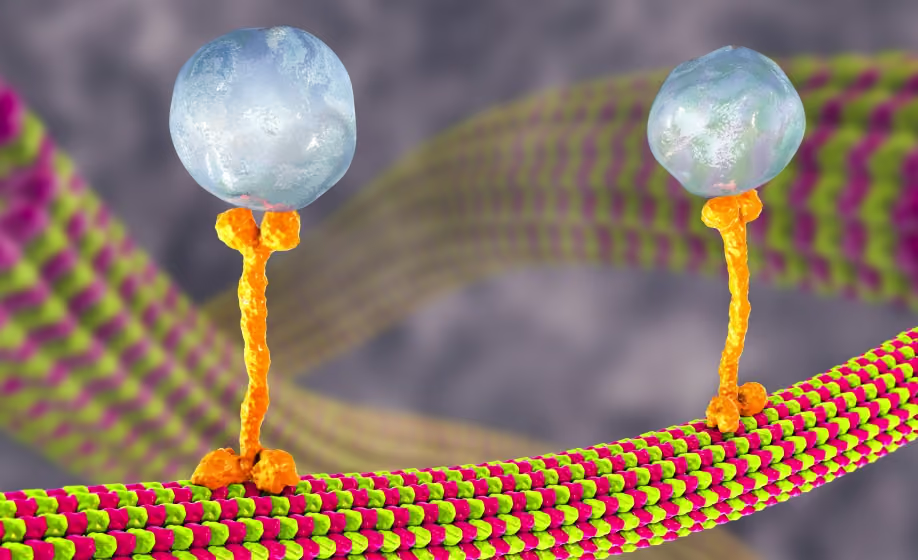
Trafficking of Endosomes and Phagosomes: Geometry, Force and CholesterolRoop Mallik, PhDUptake of material from the external world by endocytosis/phagocytosis supplies nutrients to cells, and is also critical for cell signaling. The journey of endosomes/phagosomes begins at the cell periphery and ends at lysosomes near the cell center. I will discuss how the balance of forces generated by antagonistic motor proteins guides this journey, and how lipids are emerging as a master-controller of this balance.
Calcium BufferingErwin Neher, FRSResearchers use calcium-chelators (buffers) to manipulate levels of free intracellular calcium concentration ([Ca2+]i) and to shape Calcium signals. Unlike pH buffers, which are used to strictly control pH levels, calcium buffers inside a living cell may not influence the steady-state level of [Ca2+]i at all, but rather slow-down [Ca2+]i-changes induced either endogenously or by the experimenter. Such properties and their consequences on Ca2+-imaging will be discussed.
Featuring Insights from
Ole Petersen
MD, CBE, FRS
Ole Petersen, CBE, FRS, the founding editor-in-chief of Function, is a professor at Cardiff University’s School of Biosciences in Wales. Petersen pioneered single channel current recordings in epithelial cells, discovering hormone-evoked, messenger-mediated ion channel activation and voltage-activation of epithelial ion channels. This led to the now generally accepted concept of how ion channels control exocrine fluid secretion.
Among Petersen’s accolades, he is an elected Fellow of The Royal Society and a Commander of the Order of the British Empire. He has been awarded Academia Europaea’s 2020 Gold Medal for Services to European Science.

Roop Mallik
PhD
Roop Mallik, PhD, is a professor at Tata Institute of Fundamental Research’s Department of Biological Sciences. Mallik is a biophysicist who specializes on nanoscale molecular motor proteins that transport materials, ranging from endosomes to viruses, within cells.
For his pioneering work, Mallik has received numerous awards, including the prestigious Shanti Swarup Bhatnagar Prize for Science and Technology in 2014 and Infosys Prize in 2018.
Erwin Neher
FRS
Erwin Neher, FRS, is professor emeritus at the Max Planck Institute for Biophysical Chemistry in Göttingen, Germany. Neher is a biophysicist who pioneered the patch clamp, the first device to measure the flow of electrical current through single-ion channels. Neher was appointed director of the Department of Membrane Biophysics in 1983 (through 2011) and three years later also became honorary professor at the Georgia Augusta.
He has received several awards, including the Gottfried Wilhelm Leibniz Prize, the highest honor awarded in German research. In 1991, Neher received the Nobel Prize for Medicine for discoveries regarding the function of individual ion channels in cells (together with Bert Sakmann).
In Partnership with

Function
From organelles to organisms, Function seeks papers that contribute to defining the mechanistic basis of living systems in health and disease. Function aims to be a highly selective journal, publishing major advances that extend physiological understanding of biological function and the changes associated with disease states.
Function provides a high caliber and broad spectrum open-access platform for researchers to publish their major advances in basic, translational, and clinical sciences. We value your science and want it shared with the global community. We are committed to providing authors a final decision after the initial review, even if some revisions are requested. While additional experiments may be requested by the reviewers, the final outcome of the experiments will not impact the acceptance of the article.
Function publishes original full research articles, but also short Focus articles that report an important new observation, based on solid evidence, but without the full exploration required for a full paper. All full research articles will be accompanied by a perspective article, written by an acknowledged expert in the field. A new type of Evidence Review article, quoting only original papers, will be commissioned from leading experts, but suggestions for such articles are welcome. All scientific content published in the journal goes through a comprehensive, quick, and fair review process overseen by experts in the field, but in addition Function will also publish editorials and opinion pieces.

American Physiological Society
Founded in 1887, the American Physiological Society is a global leader in expanding knowledge related to biological function. We connect a multidisciplinary community of nearly 10,000 scientists and educators from around the world, driving collaboration and spotlighting scientific discoveries in physiology and related disciplines. Our members are advancing treatments and cures for everything from cancer and heart disease, to obesity and addiction. They are also deepening our insight into living organisms generally, helping us to better understand how things like climate change are affecting the world around us.

.avif)