Webinar Summary
- Learn about the CFU assay and its characteristics as a biological tool in assessing hematopoietic stem and progenitor cells.
- Discover the utility of using bioassays to assess product potency in hematopoietic cell therapy workflows.
- Review methods to validate the CFU assay as an in-house potency assay.
- Explore ways to standardize and improve CFU assay throughput.
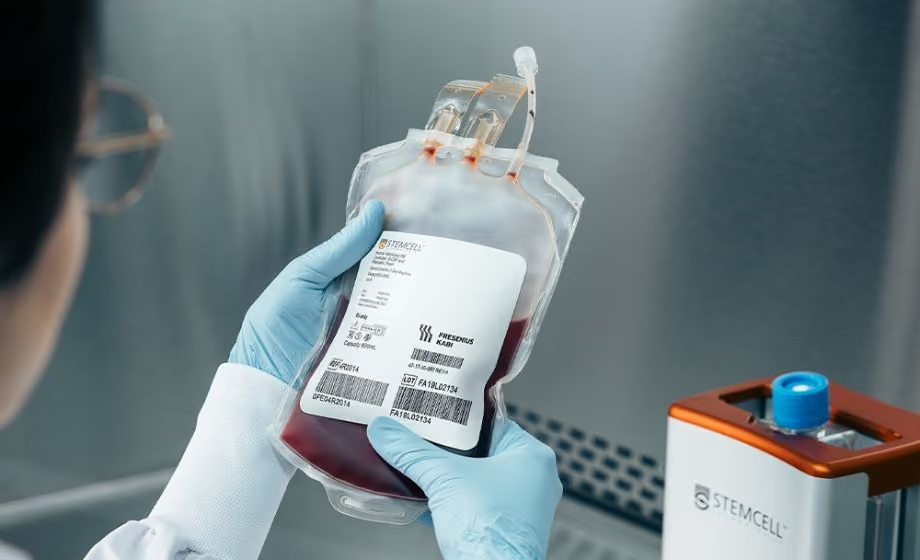
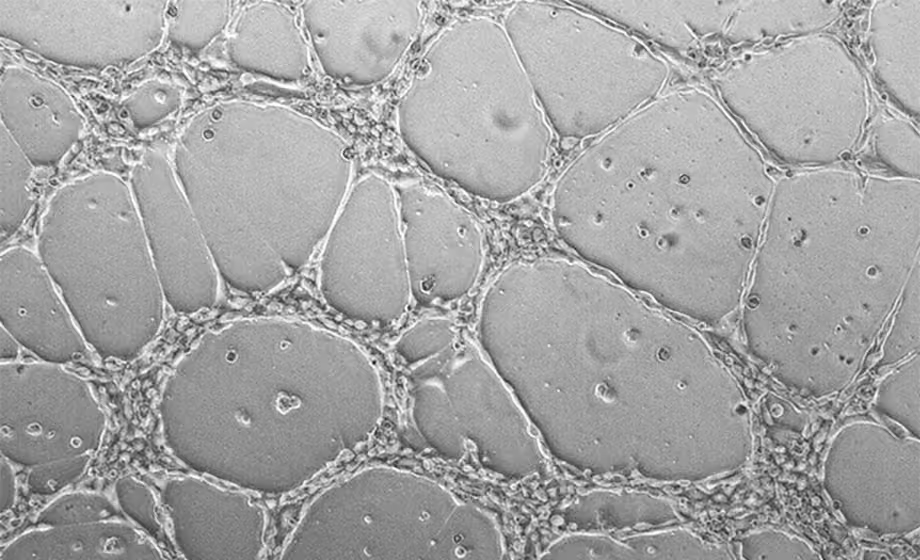
FDA recommendations require quantitative assays to demonstrate the functional potency of cell therapy products. For hematopoietic cell therapy products (HCTP), hematopoietic stem and progenitor cell (HSPC) potency can be measured by assessing the number of colony-forming units (CFU) using the CFU assay. Furthermore, in patients receiving unrelated allogeneic cord blood transplants, functional potency, measured by the total number of CFUs, has been shown to best correlate, among other parameters, with overall survival and the time to neutrophil and platelet engraftment. Validating the CFU assay as a potency assay requires demonstrating its specificity, accuracy, precision, linearity, and reproducibility. Once validated, the CFU assay can be used to assess product quality and consistency at multiple stages of the HCTP processing and manufacturing workflow.
In this webinar, Dr. Colin Hammond from STEMCELL Technologies will discuss some of the regulatory guidance around HCTP, as well as how to validate the CFU assay as a potency assay that can be integrated into cell therapy manufacturing workflows.
Featuring Insights from

Colin Hammond
PhD
Dr. Colin Hammond works as a Scientist at STEMCELL Technologies, optimizing and developing assay workflows. He has spent 10 years investigating the functional and molecular heterogeneity of human hematopoietic stem and progenitor cells, focusing on the processes of aging, differentiation, and leukemic transformation.
Sponsored by

STEMCELL Technologies Inc.
In Partnership with

Scientist.com
Scientist.com is the world’s largest and first platform built for the intricacies of scientific outsourcing.
We help pharmaceutical and biotechnology organizations discover, engage, manage, and scale relationships with the providers that support every stage of the pipeline—from discovery and preclinical research to clinical development, manufacturing, medical affairs, and commercialization. Through a centralized platform, organizations can access a global network of 6,000+ providers, streamline sourcing and procurement workflows, maintain compliance, manage supplier relationships, and leverage data-driven insights to make faster, more informed decisions.
Today, Scientist.com supports more than 130 life science organizations, including 24 of the world's top 30 pharmaceutical companies, helping teams reduce operational complexity, accelerate timelines, and bring innovations to patients faster. Our mission is to make it possible to cure all human disease by 2050.



















.avif)