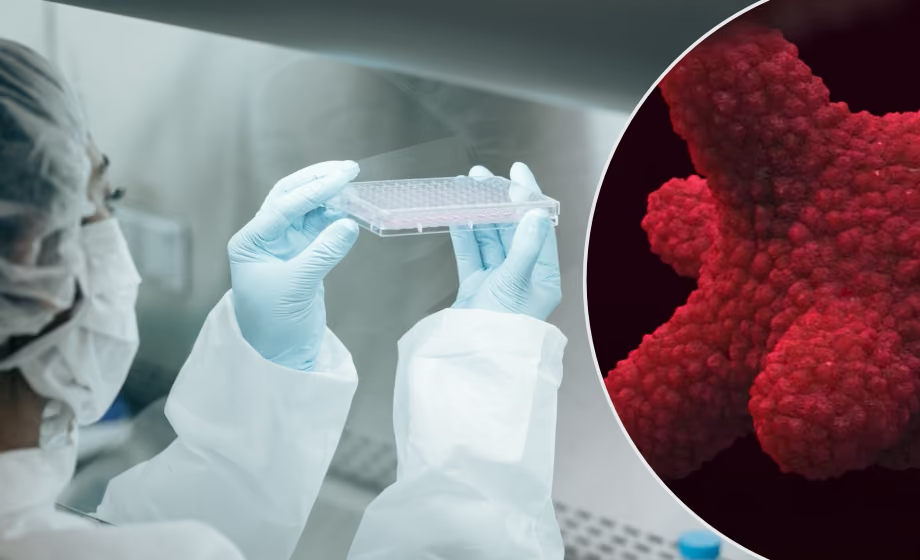
Dr. Audrey Dubourg and Dr. Gareth Guenigault explore the value that an organ-on-a-chip approach can bring to drug discovery and development workflows, and how the regulatory landscape is shifting to encourage their widespread adoption.
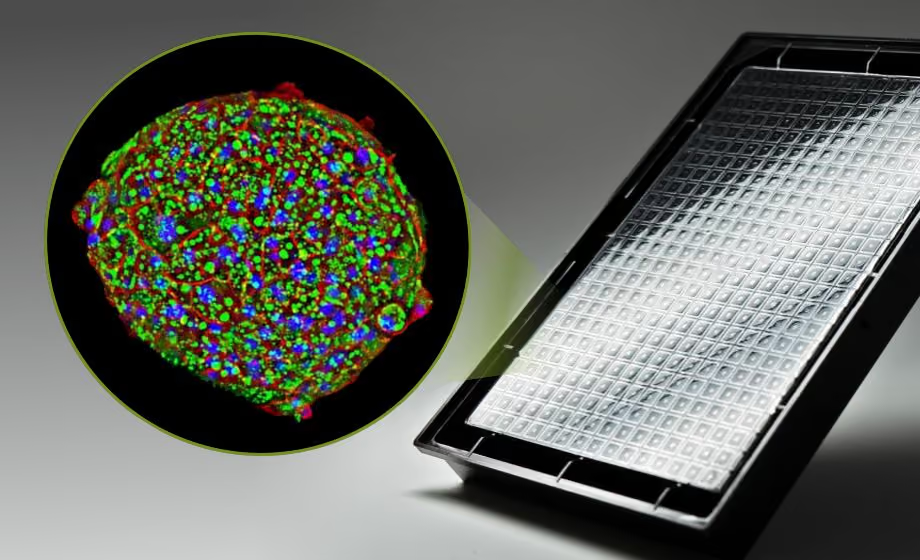
The process of discovering new drugs is both challenging and inefficient. A contributing factor is the inability of traditional preclinical experiments to predict drug safety and efficacy in humans. To bridge the gap between traditional preclinical models and human studies, Organ-on-a-chip (OOC) advances towards the simulation of human biological conditions in the lab. The technology provides predictive, human-relevant data to facilitate more informed decisions about which medicines to take into the clinic. Its potential has piqued regulator interest and, alongside other new approach methodologies (NAMS), is driving regulatory change.
In this webinar, CN Bio's PhysioMimix OOC Product Manager, Dr. Audrey Dubourg, and Lead Scientist Dr. Gareth Guenigault explore the value that an OOC approach can bring to drug discovery and development workflows, and how the regulatory landscape is shifting to encourage their widespread adoption.
Using Liver-on-a-chip as an example, the webinar explores how OOC technology supports researchers to uncover novel mechanistic insights into a broad range of biological processes, identify novel therapeutic targets, investigate drug efficacy, profile pharmacokinetics and flag potential toxicity. Case study data from pharma/biotech and our long-standing collaboration with the US FDA is presented to demonstrate how predictive OOC data is improving the efficiency of drug discovery.
Featuring Insights from
Gareth Guenigault
PhD
Dr. Gareth Guenigault is a Lead Scientist at CN Bio, an Organ-on-a-Chip company based in Cambridge UK. Gareth is responsible for the Contract Research Services arm of CN Bio’s business, where he oversees the design and implementation of customer studies to test novel therapeutic candidates using the company's advanced in vitro 3D models. Gareth and his team have played an instrumental role in the development of CN Bio’s human NASH model. They have created a set of highly customizable, industry-proven, set of assays that replicate the key elements of human non-alcoholic fatty liver disease and NASH. Before joining CN Bio, Gareth completed a PhD at Cardiff University before accepting a Post-Doc position at Cambridge University focused on the fields of Virology and Immunology.
Audrey Dubourg
PhD
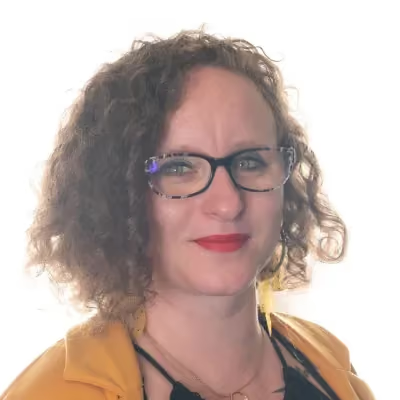
Dr. Audrey Dubourg is CN Bio’s Product Manager for the PhysioMimix™ OOC range of microphysiological systems. Prior to joining CN Bio, she worked as a postdoctoral scholar at the University of California – Los Angeles (UCLA), in the US, in the Microbiology, Immunology and Molecular Genetics department. She completed an MSc in microbiology at the University of Montpellier II, followed by a PhD in microbiology/parasitology at the University of East Anglia. Audrey has extensive experience in the disciplines of molecular biology and 3D mammalian cell culture. Since joining CN Bio, she has been actively involved in promoting the benefits of incorporating organ-on-a-chip technology into drug discovery and development workflows.
Sponsored by
CN Bio
In Partnership with
Scientist.com
Scientist.com is the world’s largest and first platform built for the intricacies of scientific outsourcing.
We help pharmaceutical and biotechnology organizations discover, engage, manage, and scale relationships with the providers that support every stage of the pipeline—from discovery and preclinical research to clinical development, manufacturing, medical affairs, and commercialization. Through a centralized platform, organizations can access a global network of 6,000+ providers, streamline sourcing and procurement workflows, maintain compliance, manage supplier relationships, and leverage data-driven insights to make faster, more informed decisions.
Today, Scientist.com supports more than 130 life science organizations, including 24 of the world's top 30 pharmaceutical companies, helping teams reduce operational complexity, accelerate timelines, and bring innovations to patients faster. Our mission is to make it possible to cure all human disease by 2050.


.avif)