Webinar Summary
- Understanding the advantages and limitations of SECCM
- Development and application of integrated scanning electrochemical cell microspectroscopy and scanning electrochemical cell impedance spectroscopy
- Challenges and outlook for SECCM in energy and materials applications
The electrode-electrolyte interface (EEI), also known as the electrified interface, is considered the heart of any electrochemical system and is relevant to various applications and phenomena, including fuel cells, batteries, and corrosion. The complexity of intertwined interfacial reactions and the heterogeneous distribution of active sites, surface defects, and particle sizes in active catalytic materials often influence chemical reactivity at EEIs. Most electrochemical techniques expose the entire surface to reactive elements at the same time, thus introducing challenges to tracking site-dependent activity. However, such local information is crucial for establishing how chemical heterogeneity affects material performance.
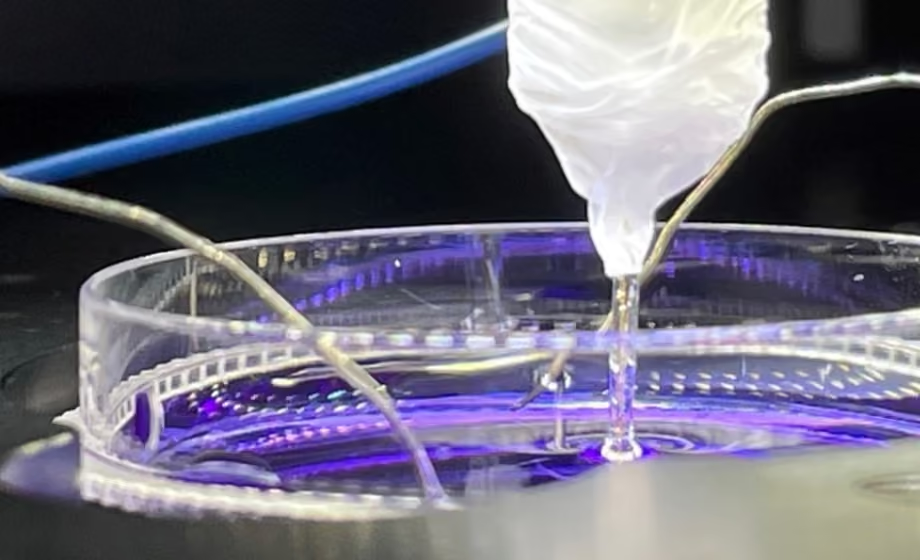
Visualizing the reactivity of individual EEI component using single-entity electrochemical imaging provides an unprecedented opportunity to deconvolute the intertwined reactions that hinder a deeper understanding of critical interfacial processes. Scanning Electrochemical Cell Microscopy (SECCM) is a newly developed microscopic-scale , droplet-based, electrochemical imaging technique that captures the activity at localized or confined regions of surfaces.
Dr. Prabhakaran will discuss the distinguishing features of SECCM and his recent work employing this technique to answer challenging questions in energy- and corrosion-related applications. He will demonstrate how SECCM may be combined with microspectroscopy and electrochemical impedance spectroscopy, which ultimately enables spatially resolved correlative mapping of both electrochemical activity and the capture of transient intermediate species at functional interfaces, therby providing a powerful new methodology to characterize technologically relevant surfaces.
Featuring Insights from

Venkateshkumar Prabhakaran
PhD
Venkateshkumar (Venky) Prabhakaran received his B. Tech. in Chemical and Electrochemical Engineering from the Central Electrochemical Research Institute in India in 2009 and his Ph.D. in Chemical Engineering from the Illinois Institute of Technology in 2014. After his postdoctoral appointment at Pacific Northwest National Laboratory (PNNL) (2014-2017), he became a research scientist in March 2017. He also holds a joint appointment as Assistant Professor in the Gene and Linda Voiland School of Chemical Engineering and Bioengineering at Washington State University, Pullman. His research interests lie at the confluence of molecular-level understanding of ionic interactions and nanoscale phenomena at electrochemical interfaces, and the rational design of efficient and sustainable electrochemical separation and energy storage systems.
Sponsored by