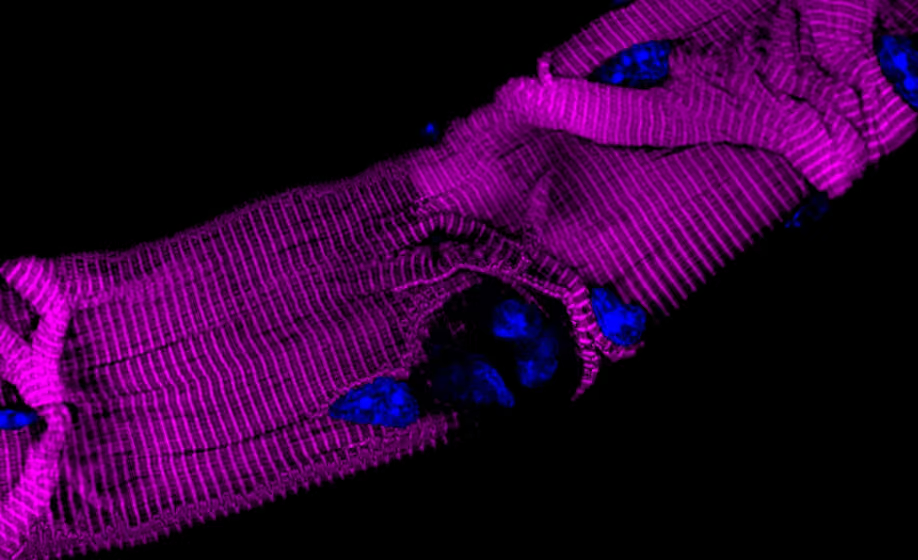
lorem lorem lorem lorem lorem lorem lorem lorem lorem lorem
lorem lorem lorem lorem lorem lorem lorem lorem lorem lorem lorem
Featuring Insights from
Adam Goodwill
PhD
Adam Goodwill received his PhD in the laboratory of Dr. Jefferson Frisbee at the West Virginia University School of Medicine in Morgantown WV. He performed his post-doctoral work in the laboratory of Dr. Johnathan Tune at the Indiana University School of Medicine in Indianapolis IN. Dr. Goodwill has held an academic appointment at Indiana University School of Medicine since 2015. The primary focus of Dr. Goodwill’s research career has focused on vasomotor deficits and vascular remodeling in the context of the metabolic syndrome. More recently, his work has focused on the the coordination of coronary blood flow with cardiac function under a variety of disease conditions.
Ongoing projects by his research group intend to develop new and innovative large animal models of heart failure under varying conditions. The lab’s studies routinely include a series of experimental approaches utilizing both in vivo (chronically instrumented conscious and/or acute open-chest swine) and in vitro (isolated artery rings, pressurized arterioles, Western blot, RT-PCR, immunohistochemistry, confocal microscopy) methodologies.
Sponsored by

3i - Intelligent Imaging Innovations
In Partnership with
American Autonomic Society
The American Autonomic Society (AAS) has been established to bring together individuals from diverse disciplines who share an interest in the structure and function of the autonomic nervous system and in the pathology, treatment, and prevention of its disorders. The Society sponsors annual meetings and provides a point of contact among the many interested clinical and basic scientists who wish to communicate across disciplinary lines.
The AAS began informally in 1990 at Vanderbilt University in Nashville, Tennessee. Important motivating force for the initial meeting were Dr. David Robertson and Ms. Dorothy Trainor-Kingsbury (Shy-Drager Support Group). The Society was formally established in 1992, and Dr. Robertson became its first president. The broad aim of the AAS is to provide a vehicle for investigators and clinicians interested in the autonomic nervous system to interact. It aims to promote research, education, and the academic practice in the autonomic disorders. The Society has escalated in its membership, successfully obtained tax-exempt status, adopted a formal charter, and has its own journal (Clinical Autonomic Research).
The Society has an American infrastructure but a strongly international character. Its membership is open to persons of all countries who share the same interests. During the past quarter century, the AAS has expanded from less than 50 members in 1992 to over 150 members today, focusing on both clinical and basic science, and has taken on a new role in the education of physicians in autonomic disorders. The collegial atmosphere and ongoing collaborative efforts has sparked several important discoveries that directly impact the lives of people with autonomic disorders. Partnerships with support groups have expanded the reach of the AAS into the public eye, while partnerships with industry have culminated in approval of new therapies for people with autonomic disorders.





.avif)