Data-independent acquisition (DIA) has become the method of choice for large-scale discovery proteomics. Its application for single-cell analysis promises to be more sensitive, robust, and reproducible than other proteomic approaches but is still a fairly unexplored territory.
Data-independent acquisition (DIA) has become the method of choice for large-scale discovery proteomics. Its application for single-cell analysis promises to be more sensitive, robust, and reproducible than other proteomic approaches but is still a fairly unexplored territory.
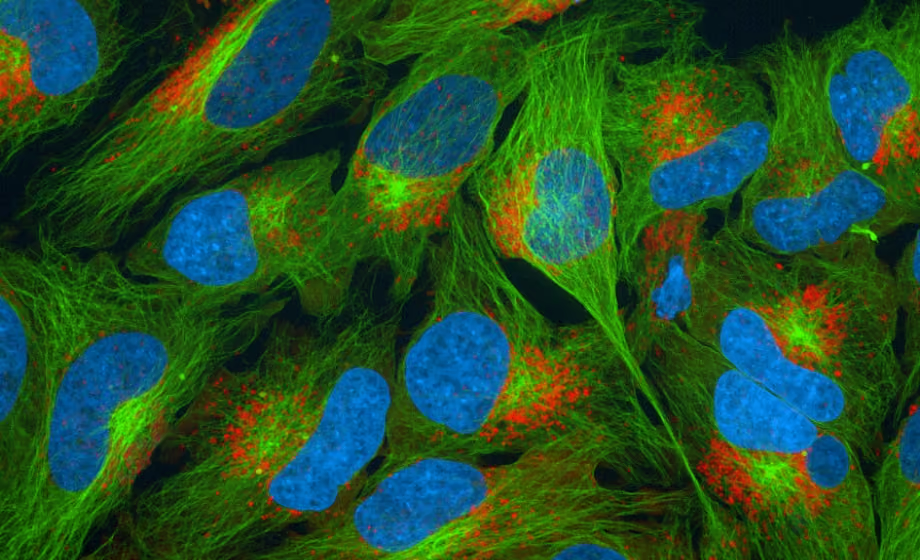
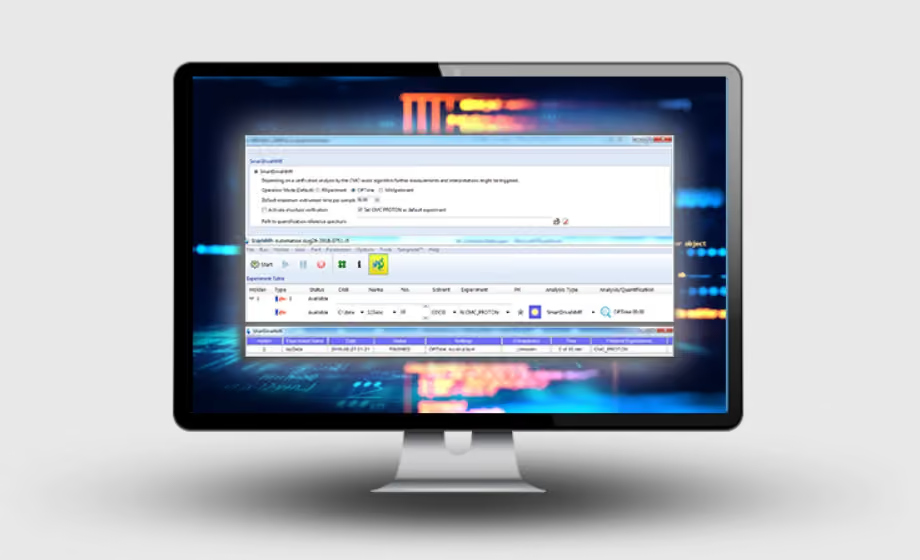
In this webinar, Andreas-David Brunner presents a robust and scalable single-cell DIA proteomics workflow using ion mobility technology (dia-PASEF), developed at the Max Planck Institute of Biochemistry (Matthias Mann Lab). The team quantified up to 1,500 proteins in a drug perturbation experiment using Spectronaut - the gold standard software for DIA proteomics. In a second step, they compared single-cell proteomics data to publicly available single-cell RNA-sequencing data, revealing fundamental differences in regulation between the two modalities.At this event, Biognosys launches the much-awaited Spectronaut 15. The latest version of the software comes with many novel and improved applications. Oliver M. Bernhardt, the lead developer of Spectronaut, shows you how to take advantage of these new features:
- Benefit from significant improvements to directDIA, the industry-leading workflow for DIA analysis without a spectral library
- Gain deeper insights into the biological roles of protein modifications, with more comprehensive PTM site analysis
- Learn about the improved deep learning augmentation with significant advantages for immunopeptidomics and ion mobility data analysis
- Experience the most powerful data visualization for DIA proteomics, now in an even more intuitive user interface
Featuring Insights from
Oliver M. Bernhardt
After finishing his studies in bioinformatics and software development at the University of Applied Science Hagenberg in Austria, Oliver joined the Biognosys team in 2011 where he started the development of a new SWATH / DIA analysis software which would later become known as Spectronaut. Since then, Oliver has been working as lead developer for Spectronaut and is a key contributor to other Biognosys software, as well as high impact publications.
Andreas-David Brunner
PhD
Andreas-David Brunner received his Bachelor and Master of Science in Molecular Biotechnology from the Technical University of Munich with a stay abroad at Harvard University. Since 2017, he is a Postdoctoral Researcher in the Department for Proteomics and Signal Transduction with Matthias Mann at the Max Planck Institute of Biochemistry in Munich, Germany. Andreas is working on the implementation of novel trapped ion mobility spectrometry instrumentation and methods with a focus on ultra-high sensitivity Proteomics applications in the biomedical arena.
Maximilian J. Helf
After graduating from the Molecular Biomedicine program at the University of Bonn, Max received a PhD in Microbiology from ETH Zurich in 2015 for his work on highly modified peptide natural products. As a postdoc at Cornell University, he developed data analysis tools for untargeted metabolomics. Since 2019, Max has helped maintain Biognosys’ market-leading position with in-depth assessments of proteomics software performance. In his role as Product Manager, he further leads the software release activities of the company.
Sponsored by