As expectations mount for stakeholders to demonstrate value, for teams working in HEOR, RWE, and Market Access a common challenge is emerging: how can you proactively plan for future projects without duplicating efforts, creating gaps in the data, or starting too late?
After attending ISPOR 2025, there was a clear call to action: in order to build a fully integrated, cross-functional evidence plan, we must start with the end in mind, while also leaving room for evolution and flexibility. Whether you call it a Book of Work or an evidence roadmap, it’s no longer a nice-to-have—it’s essential.
Here are five questions that will help transform your value evidence plan into a true strategic asset.
1. What decisions are you trying to support and when?
One of the most consistent takeaways from ISPOR this year was the need to design trials and evidence generation with the end goal in mind. That includes HTA submissions, pricing negotiations, and payer reviews. It is important to consider:
- Which stakeholders will need to evaluate this evidence?
- What are the timelines for HTA assessments, formulary decisions, or access milestones?
- What evidence will they expect to see?
This early clarity allows you to reverse-engineer your plan, ensuring the right data is available when it matters most. Don’t simply design studies; design outcomes that answer future value questions.
2. Are our evidence plans truly integrated?
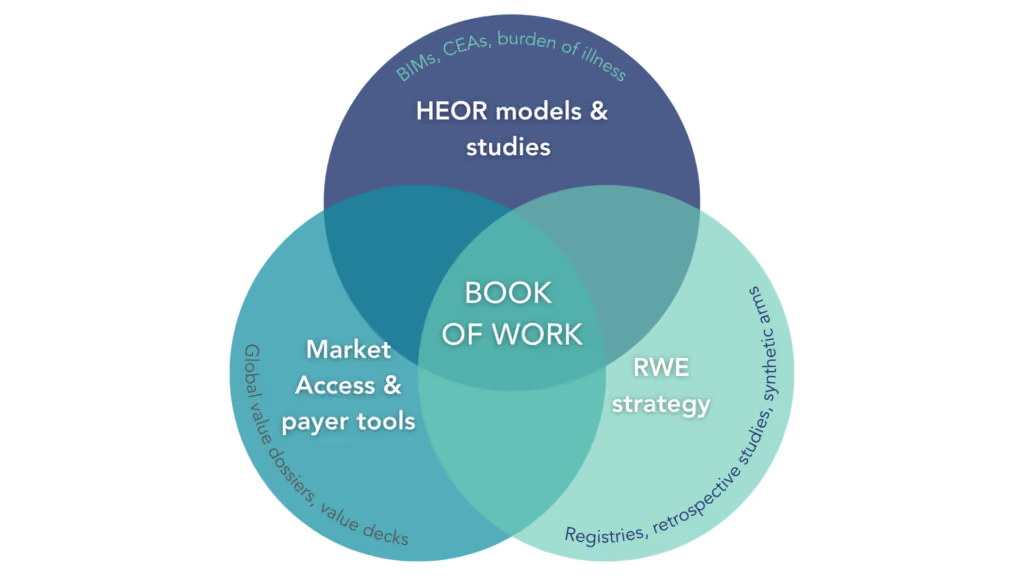
Cross-functional alignment isn’t exactly new advice, but at ISPOR 2025, we heard the message loud and clear; in this new age it is non-negotiable. Without integration between HEOR, RWE, clinical development, and market access, teams risk producing data that is fragmented and can’t tell a clear or coherent value story.
An effective Book of Work brings together: HEOR models & studies, RWE strategy, and Market Access & payer tools. When these three main functions are siloed, redundancies increase, timelines slide out of scope, and key stakeholders are left unconvinced.
3. Are we using real-world data as a strategic starting point?
Another strong theme coming out of ISPOR was real-world data (RWD). This should be the strategic starting point, not a post-launch add-on. RWD can be used to inform clinical trial design, population sizing and treatment pathway mapping, as well as unmet needs and disease burden assessments. Introducing RWD early also sets the stage for generating real-world evidence (RWE) that is genuinely supportive of both internal decisions and external value demonstrations.
4. Is RWE included early and often enough throughout our plan?
Closely tied to RWD is RWE, which should be integrated across the lifecycle as well, and not treated as a separate workstream. At ISPOR, speakers emphasized the importance of RWE in:
- Validating modeled assumptions
- Demonstrating treatment persistence and adherence
- Capturing patient-reported outcomes and heterogeneity of effect
- Supporting renewals or reassessments by HTA bodies
Including RWE early helps bridge the gap between trial data and payer needs, and when well executed, RWE can even shift outcomes.
5. Are we accounting for market-specific adaptations and timelines?
A global plan is a great starting point, but local success depends on your ability to adapt.
Definitely ask:
- What are the local HTA expectations (e.g., G-BA, CADTH, NICE)?
- Do we need localized cost, comparator, or epidemiological data?
- Are we budgeting for affiliate-led adaptation of models or value decks?
Build flexibility into your Book of Work so that local teams can tailor materials without reinventing or staring over.
Final Thoughts: Plan Early, Plan Together, Plan for Impact
Gone are the days of fragmented and last-minute evidence planning. If there’s one thing ISPOR 2025 made clear, it’s this: plan early – with the end in mind; plan together – integrating cross-functionally; and plan for impact by embedding real-world data from the start. This is the only way forward.
A strong and well structured Book of Work should be strategic, flexible, and living. Having clear ownership, a strong vision, and regular review cycles helps ensure that your value story is credible, complete, and ready (not reactive) when all stakeholders need it most. And remember—your evidence plan is about more than what you’ll generate. It’s about why, when, and how that evidence will drive real-world impact.
How Scientist.com Can Help
Scientist.com is the world’s leading R&D marketplace, used by over 20 of the top 30 global pharma and biotech companies, and with over $150M in HEOR, RWE, and Market Access research sourced. The Value, Evidence, and Access Marketplace was built specifically to connect buyers with trusted HEOR, RWE, and market access service providers—securely and efficiently.
Click the button below to connect with our Medical/Commercial Marketplace specialist today!

Take the Next Step
Explore Suppliers
Browse trusted partners with relevant expertise
Review Capabilities
Compare services, experience, and past work
Start Your Project
Connect and begin collaborating
.png)

.jpg)




.png)
.avif)



.avif)