Drug discovery still breaks down in the places that matter most: sparse data, novel biology, unconventional binding sites, and targets that do not behave like the well-studied systems most machine learning models have seen before.
For many of the hardest programs, the bottleneck is not a lack of algorithms. It is a lack of methods that can generalize beyond historical data while remaining fast enough to matter in real-world discovery.
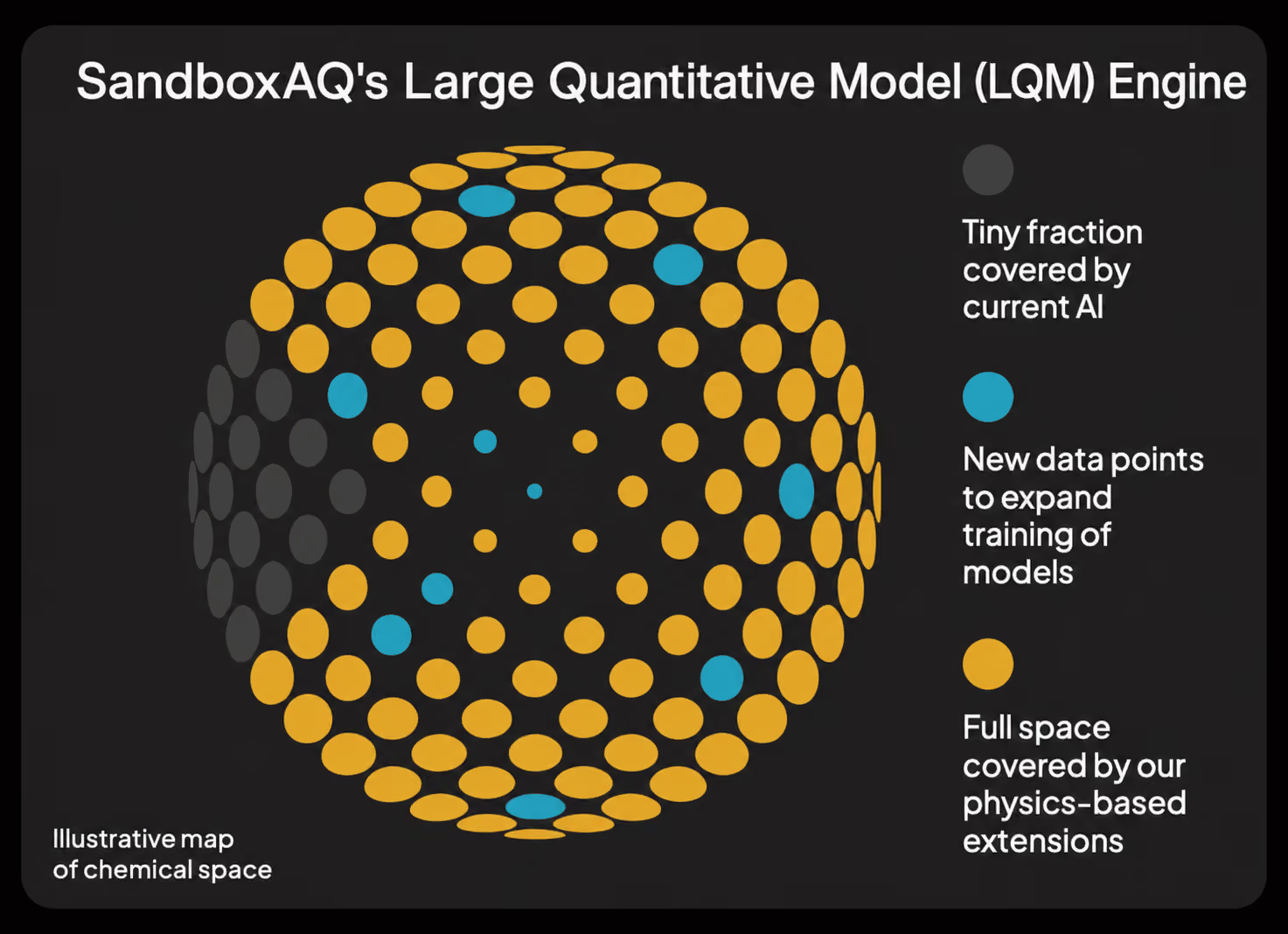
At SandboxAQ BioSim, the working premise is that this gap cannot be closed by AI alone or by physics alone. The more effective path is to combine both: use machine learning to broaden and accelerate search, and use physics-based simulation to deliver the quantitative rigor needed for harder decisions. That hybrid strategy sits at the center of BioSim's Large Quantitative Model, or LQM, engine.
SandboxAQ is a science-first technology company spun out of Alphabet in 2022, and its BioSim division launched in 2023 to apply AI- and physics-based methods to drug discovery and development. BioSim's mission is accelerating breakthroughs by solving hard chemistry and biology problems with a combination of data, AI, physics, and automated workflows.
Why conventional approaches still miss too much
Pure AI approaches are powerful, but they remain constrained by the data they were trained on. AI models struggle to extrapolate reliably to unseen chemistries, novel targets, or sparse-data settings. Physics-based approaches, by contrast, can offer higher-fidelity predictions, but they are often too computationally intensive to deploy broadly at screening scale.
That tradeoff is especially painful in virtual screening. Discovery teams want to search larger and more diverse chemical space, but they also need confidence that the compounds prioritized computationally will survive experimental follow-up. The LQM framing is designed around exactly that tension: expand what machine learning can predict, accelerate what physics can compute, and benchmark workflows rigorously enough to identify the right method mix for each target.
A stack designed for the full discovery continuum
One notable feature of the BioSim VS strategy is that it is not a single-point solution. The platform spans target discovery, hit finding, lead optimization, and translational biomarker discovery, with a knowledge graph foundation underneath and a hybrid modeling layer above it.
The stated goal is to connect biomedical knowledge, molecular simulation, machine learning, and generative AI into a single workflow that can produce actionable predictions across the R&D continuum.
BioSim has supported more than 20 programs across 10 indications and three modalities, including antibodies, small molecules, and mRNA vaccines. The team of more than 250 people and $950M in long-term capital intended to scale the platform and partnerships rather than build a competing internal clinical pipeline.
The infrastructure is based on a strategic compute integration with NVIDIA, Google Cloud, and AWS as a way to run large-scale physics simulations at the speed required for modern discovery programs.
What hybrid AI plus physics looks like in practice
In practice, the hybrid model appears as a modular toolkit rather than a monolithic workflow. The strategy provides target-specific combinations of docking, cofolding, free energy calculations, protein-ligand interaction models, active learning, surrogate models, and library optimization.
Rather than forcing every program through the same funnel, the idea is to assemble and tune workflows around the biological problem at hand. This matters because different problems fail for different reasons. Some targets are data-poor. Some depend on protein flexibility. Some involve allosteric or unconventional pockets. Some require broader exploration of chemical space than traditional screening campaigns can afford. Every problem has a different optimal solution, and benchmarking is essential to finding it.
Evidence from virtual screening and hit finding
This strategy has been optimized and validated with several prospective and retrospective examples showing how workflow optimization can translate into better screening performance.
In one neuroscience-focused small-molecule discovery example, the work focused on an intractable target with an unconventional binding site. The result was a 10x faster progress, a more than 30x improvement in hit rate, exploration of far broader chemical space, and sharply lower screening cost relative to traditional high-throughput screening.
In another case centered on a challenging phosphatase target with no known inhibitor, the custom AI- and physics-based screening workflow was applied to a library of roughly 6 million compounds. From 173 purchased and screened compounds, the team reported 20 actives, corresponding to an 11.6% hit rate, alongside lead hits with approximately 10 µM IC50, greater than 90% maximal inhibition, and more than 300-fold selectivity versus an off-target.
Why physics still matters at scale
High-accuracy physics is not just a boutique validation tool, but something that can now operate at practically useful scale.
Physics does not need to replace machine learning, and machine learning does not need to replace physics. The highest leverage comes from coupling them so that one method expands the search space while the other sharpens confidence in what to test next.
Success in discovery is not just about having better models.
It is about designing better workflows. We need to explicitly frame virtual screening as a workflow optimization problem, with rigorous retrospective validation as the foundation for prospective performance. That framing is important for the field more broadly.
The future of computational drug discovery may be less about finding one universal model and more about building systems that can benchmark, adapt, and improve as projects evolve. We are creating the "agentic virtual screening," where benchmark design, workflow search, and decision-making become increasingly automated while scientists remain in the loop.
The bigger takeaway
For years, drug discovery platforms have promised faster screening, broader search, and better prioritization. What distinguishes the most credible newer approaches is not the promise itself, but the attempt to ground that promise in quantitative physics, modular workflow design, and prospective results on difficult targets.
If the next phase of the field is about screening the unscreenable, then the real challenge is not choosing between AI and physics. It is learning how to combine them well enough that novel biology, sparse data, and complex modalities stop being edge cases and start becoming tractable discovery problems.
Take the Next Step
Explore Suppliers
Browse trusted partners with relevant expertise
Review Capabilities
Compare services, experience, and past work
Start Your Project
Connect and begin collaborating
Sponsor

.png)
.avif)


.avif)