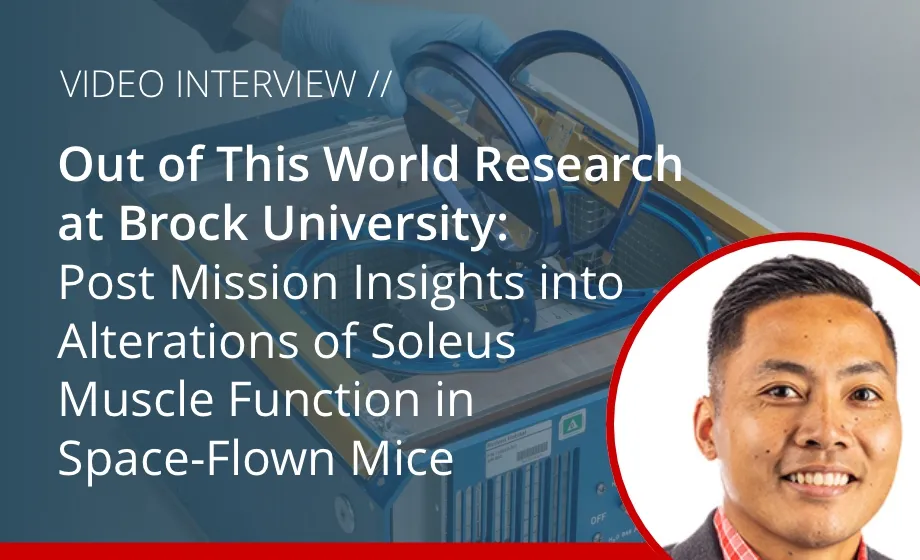
Out of This World Research at Brock University: Post Mission Insights into Alterations of Soleus Muscle Function in Space-Flown Micehttps://insidescientific.com/wp-content/uploads/2024/04/ASI-Blog-Photo-Fajardo-Lab-1-1024x400.png In late 2023 , we had the pleasure of sitting down with Dr. Val Fajardo, Canada Research Chair and Head of the Muscle Plasticity in Health and Disease lab at Brock University, as well as two graduate researchers in his lab Jessica Braun and Briana Hockey. Their team were some of the first to analyze tissue samples from NASAs SpaceX CRS-29, a commercial resupply services mission to the International Space Station (ISS) launched on November 9th. These samples from the Rodent Research-20 (RR-20) payload , which has since returned to Earth, is being examined to determine the effects of month-long space flight on female reproductive health. The RR-20 payload aims to determine whether space travel permanently or temporarily impacts the reproductive capabilities of female mice, and if resulting bone loss is associated with hormonal imbalances. Through NASAs Biospecimen Sharing Program , Dr. Fajardos lab was also able to analyze the effects of spaceflight on muscle contractility and function using cutting-edge equipment from Aurora Scientific. This project extends Dr. Fajardo's lab's ongoing partnership with NASA and builds on their prior research analyzing how space travel affects muscle and bone at the cellular level. Alongside other researchers from around the world, Dr. Fajardos group made use of the 1200B Isolated Muscle System from Aurora Scientific to analyze these recently returned samples. Hear from Dr. Fajardo, Jessica, and Briana on their post-mission experience at the Roskamp Institute, data collected, and future directions of the lab in the interviews below!
Dr. Val Fajardo
In our first interview, we spoke with Dr. Val Fajardo . Through collaboration with several of the lead scientists on the RR-20 mission, NASA scientists, and the Roskamp Institute staff, this group sought to address how muscle contractility changed after spaceflight. Analysis of whole muscle contractility after spaceflight of this duration has not yet been analyzed, and so providing this data to the NASA research community is imperative.
What we found is basically bang on with the literature.
https://insidescientific.com/wp-content/uploads/2023/11/Val-Fajardo_250rb.png The soleus muscle, a broad muscle in the lower calf used for posturing and stabilizing on Earth, was unused during spaceflight. This resulted in the muscle becoming unloaded, a metabolic phenomenon which is characterized by a broad shift in muscle cell type. Most muscles have a mix of slow and fast types of muscle fibers. Slow fibers are rich in mitochondria and are more resistant to fatigue than fast types of muscle fibers, which are powerful but more fatigue-sensitive. Due to the microgravity changes experienced in spaceflight, a shift from slow to fast muscle fiber types occurs, ultimately leading to greater muscle fatigue following spaceflight. This effect is not easily reversed; although some improvement was noted two weeks after recovery, the observed fatigue remained higher than usual.
So if the female mouse goes up into space and returns back to Earth, do they pass down any of these effects from spaceflight onto their pups?
While the results from RR-20 are still in preliminary analysis, Dr. Fajardo provides some highlights. Of particular interest is their investigation on the effects of microgravity on future pregnancies following copulation with non-spaceflight mice. Both male and female F1 offspring are to be analyzed in these experiments, with potentially very interesting results. Further experiments involve biochemical analysis of this effect and correlating this functional data with genomic data. The data from the RR-20 mission experiments will be available here soon: https://osdr.nasa.gov/bio/ . [fusion_text columns="" column_min_width="" column_spacing="" rule_style="" rule_size="" rule_color="" hue="" saturation="" lightness="" alpha="" con

Take the Next Step
Explore Suppliers
Browse trusted partners with relevant expertise
Review Capabilities
Compare services, experience, and past work
Start Your Project
Connect and begin collaborating
Sponsor

.png)

.jpg)





.png)
.avif)





.avif)