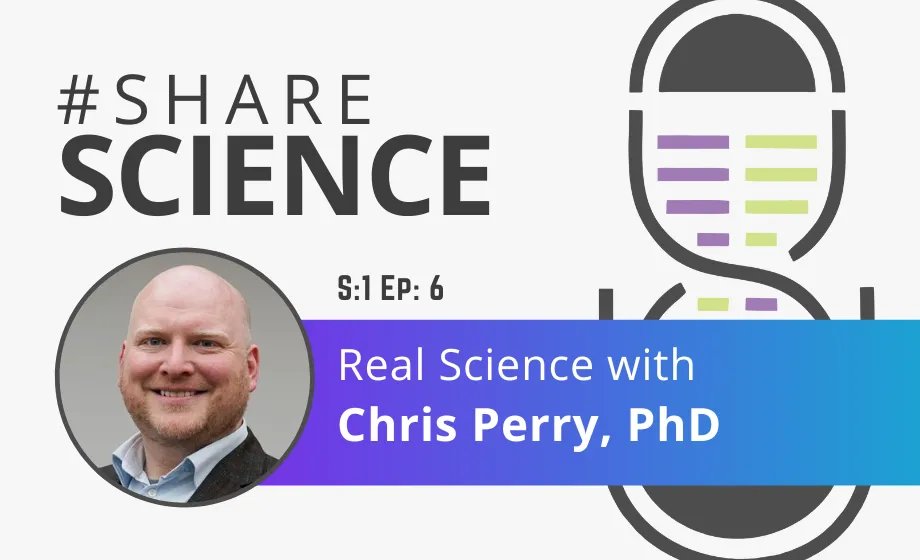
Talking Real Science with Chris Perry https://youtu.be/9YElWwLTgmM This episode of Share Science features Christopher Perry , PhD, an associate professor at York Universitys School of Kinesiology & Health Science . Chris laboratory investigates the regulation of skeletal muscle metabolism and focuses on developing therapies to improve muscle fitness in rare muscle disorders and in cancer and chemotherapy-induced muscle weakness. In this podcast, Chris not only shares his career path, but also his ideas and goals of creating a contract research organization (CRO) to further help those with muscle disease and to provide more opportunities for his trainees.
Where did you grow up and how did your youth influence your path and passion towards science?
I grew up in a few small towns outside of Toronto, usually within an hour. What I remember as a boy was my mom buying me books on astronomy, stars, and planets, and I very quickly decided one day I'd be an astronomer. Then I got into high school and one way or another started to become really fascinated with how the body works. I don't remember that transition at all, but I do remember a conversation at the end of high school with my guidance counselor. He said, "What are you interested in?" I said, "Well, human physiology, exercise science," and he said, "Have you ever heard the word kinesiology?" I said, "No," and he said, "You should look into that." I did, and I just felt that excitement. That's what I wanted to learn about. I wasn't too sure what I wanted to be, but it was Mr. Jones at Acton High School who said, "You should look into kinesiology." Now I'm in the School of Kinesiology at York University. I actually connected with him a few years ago and told him that story. That would be a big influence on me.
Before York University, where did you study and how did you end up studying muscle health and mitochondrial disease specifically?
As a fourth-year student in human kinetics at the University of Guelph, I wanted to see what research was about. I did a research project with Professor Brian Wilson, who's now retired, and he was full of enthusiasm, and still is. He had these ideas for looking at how exercise affects the ability to improve your run time to performance, and using whole body measures with a little bit of blood samples for things like VO2 max.
For me, I had no idea research could be yelling at someone on a bike. I thought it would just be sitting in this little dank lab, like first-year chemistry, mixing this chemical and that chemical and your assignment was to describe what the color change was and why that was. I got to see what human research can be.
He took me on as a master's student, and I loved it so much that I wanted to delve more into the mechanisms by which our fitness is determined, so I did a PhD with Professor Lawrence Spriet in the same department. He also did applied research, but he added muscle biopsies to that and taught me biochemistry, how to understand the regulation of very specific metabolic pathways in muscle that convert food into energy.
I did a thesis on how exercise improves the regulation of skeletal muscle metabolism in humans. I was hooked. I was absolutely hooked. I thought, "Okay, this is what I want to do. I think I want to be a professor. I'm not sure, but I know I love this." I went with what I love.
I wanted to delve more deeply within mitochondria. I also now wanted to understand how muscles get worse. I felt like I had a pretty good grasp on how muscles get better: when you stress them with exercise, you improve their fitness. I wondered if I could learn more about how to conduct clinical research on diseases that make muscle fitness decline, and I also wanted to learn how to do preclinical research in cells and rodents. I did a postdoc in North Carolina with Professor Darrell Neufer and learned both of those. I was exposed to clinical research on how overnutrition, overeating, and sedentarism leads to insulin resistance which can eventually lead to type 2 diabetes. When I came to York as faculty, I had all these plans to pursue both of those topics: exercise and type 2 diabetes. I went to a presentation on Duchenne muscular dystrophy and metabolic dysfunctional muscle, and I realized I don't know anything about muscle weakness disorders. I wondered if there was an opportunity to move sideways with the expertise I had at the cellular level and then move up in various diseases, so to speak. Diabetes and exercise were my expertise, but how creative could I be in applying that to determine two things? One, the degree to which there's mitochondrial stress in various diseases that are receiving very little attention but are linked with a theme of muscle weakness. Two, can we translate those discoveries into preclinical therapeutic development approaches?
Once we discover specific metabolic pathways that are irregular in muscle from a muscle weakness disorder, how would I ever go about testing or perhaps developing new compounds at that preclinical level? It was an evolution over the years that brought us to where we are today.
What is your typical approach for developing therapies using a preclinical model and then translating that into humans, and how does Aurora Scientific's equipment help with that?
To study a muscle weakness disorder, you need a system that measures force production within muscles. There are whole body approaches, and then there are in situ and in vitro. Aurora's system is absolutely essential for determining whether or not a drug that we are testing in a rodent prevents muscle weakness. We also add whole body measures such as grip strength or various treadmill tests. The challenge with those tests is that they're subject to the choice of the mouse to continue or to stop. There are ways to motivate ethically, but at the end of the day, they also have a behavioral component. When you think about the diseases we're studying, you wonder what level of discomfort the mice are feeling.
Maybe they're just not motivated to exercise. Does that mean they have muscle weakness? How do you determine whether reduced physical activity in any of these tests is actually due to weak muscles or some other factor like pain?
It doesn't mean that we exclude those tests; we do them, but we then add on muscle-specific force majeures. The Aurora system was the one we started with, and it's just the best and it's broadly known. It's been transformative: in fact, we've got one drug, one partnership that's using that system, that appears to be preventing weakness in the diaphragm by up to 30% in mice with Duchenne. If we didn't measure muscle force, we wouldn't know that. [fusion_title title_type="text" rotation_effect="bounceIn" display_time="1200" highlight_effect="circle" loop

Take the Next Step
Explore Suppliers
Browse trusted partners with relevant expertise
Review Capabilities
Compare services, experience, and past work
Start Your Project
Connect and begin collaborating
Sponsor

.png)

.jpg)





.png)
.avif)





.avif)