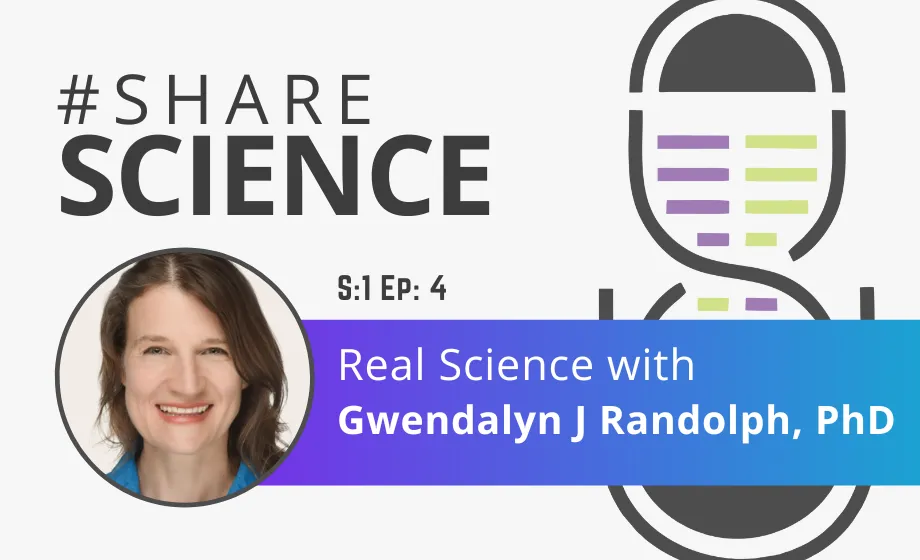
This episode of Share Science features Gwen Randolph, PhD , a pathology and immunology professor at Washington University School of Medicine in St. Louis . Last year, Gwen presented a webinar with us in our immunophysiology and inflammation series on the trafficking of microbial signals from the intestine. In this interview, Gwen shares some of her scientific passions, as well as personal experiences as a woman in science. LISTEN TO THE PODCAST:
Where did you grow up and how did your youth influence your path and passion towards science?
I grew up on a farm in the Texas Panhandle. It was a plant farm, so we grew corn, soybeans, and wheat. Honestly, I didn't necessarily have any pressures to even seek a college education, but I loved the farm itself. Actually, when I was in the fourth grade, with the help of my grandfather and my mom, I started a chicken farm mostly just for pleasure.
That, I would say, spurred my interest in biology, by hanging around and just watching the whole process of chicks being born.
Ultimately, when I was in high school, I realized that science was my favorite subject. I set out with really no understanding of what a research career could be. I initially started college relatively nearby on a basketball scholarship and studied pre-med. My first year in college, I took a histology class and I became really enamored with the structure of organs, and particularly with white blood cells on a blood smear. I was fascinated by leukocytes. That class was probably a turning point for me in terms of choosing to pursue research rather than actually becoming a physician.
Where did you study and how did you end up in immunology?
I had a basketball scholarship at Wayland Baptist University, but they didn't really have coursework that would drive me in this area that I became really interested in, like leukocyte trafficking. The biology there was more ecological so I ended up leaving, and I spent one year at a college in Arkansas.
I had this book that I was reading in the laundromat on leukocyte trafficking. Sitting there while my laundry was tumbling in the dryer, I was starting to read about how leukocytes crawl between endothelial cells to get out of blood and into tissues, and I just thought it was super fascinating.
I requested to take a self-study course in immunology because there was no such offering at the university at the time. Later on in the third and fourth years of my undergraduate education, I actually made it to the east coast where I had long wanted to be. I went to Temple University in Philadelphia. There, I did not study immunology, but continued my biology training and got an undergraduate degree in biology.
I remembered my love for leukocyte trafficking and so when I went to do a PhD, I focused on that. It's really that first love scenario.
Is there any one person who was or is the greatest influence on your career?
It's hard to point to a single person. Actually, I gave a lecture at the American Association of Immunologists a few years ago, a distinguished lecture, and I put out a slide of the people I feel like influenced me the most. I came up with a handful of people.
I think we're influenced by many people at different times.
The first person who really influenced me was Ralph Steinman, who won the Nobel Prize in 2011 for his discovery of dendritic cells. He turned out to be a co-mentor for me during my postdoc raising, and was really, really influential to me both scientifically and personally, and just really encouraging. Later on, I moved to Mount Sinai and started my first lab there. A few years after I arrived, Miriam Merad started her lab right next to mine. That was such a fantastic period, I think, that was a positive trajectory for my career. There were other people who made major contributions. Melody Swartz, who's now at the University of Chicago, influenced me by starting the process of thinking how molecules move through spaces of tissues, and so we began to collaborate. Right now, we connect our leukocyte work with lymphatic trafficking influenced by Dr. Swartz. We've even started to think about lipoproteins. My lipoprotein influence and go-to person is Mary Sorci-Thomas at the Medical College of Wisconsin. Just before I moved to Washington University, Jean-Frederic Colombel from Mount Sinai got me really interested in thinking about leukocyte and molecular trafficking from the gut in the context of inflammatory bowel disease. We interacted really only briefly, but the level of enthusiasm he had for what we were d

Take the Next Step
Explore Suppliers
Browse trusted partners with relevant expertise
Review Capabilities
Compare services, experience, and past work
Start Your Project
Connect and begin collaborating
.png)

.jpg)

.png)
.avif)


.avif)