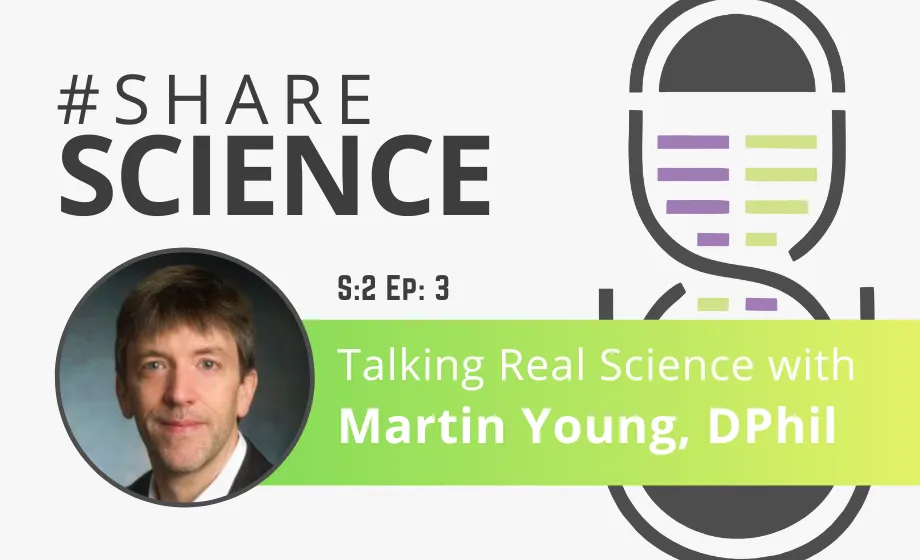
Talking Real Science with Martin Young This episode of #ShareScience features Dr. Martin Young , a professor of medicine at the University of Alabama at Birmingham (UAB). His research focuses on understanding nutrition and the timing of meals and how that influences cardiometabolic and cardiovascular health. Martin holds a deep appreciation for the art of teaching and mentorship and has dedicated himself to supporting undergraduates, graduates, medical students and postdoctoral fellows throughout his career. In this interview, Martin tells us about his journey into cardiac metabolism and chronobiology as well as some of his mentors, and the fascinating science he learned along the way. LISTEN TO THE PODCAST:
Jumping off with the first question here, where did you grow up and how did your youth influence your path and passion towards science?
Sure, it's kind of a complicated question in my case unfortunately, I guess nothing is ever straightforward. So my mother is American and my father is British, which means that I've moved back and forth across the Atlantic several times in my life. Much to the disappointment of my wife, I don't have an English accent because I spent the first ten years of my life in Ohio where my mother had familial ties. Around the age of 10, my family moved back to England and that's really where I finished all of my schooling in an area called Yorkshire.
"Throughout my childhood, I loved to solve problems and puzzles, especially those that were based on math."
I loved math problems and was a total nerd, so much so that during the last years of the equivalent to high school in Britain, I took extra math classes and got extra math qualifications. My teachers were convinced that when I went to university I was going to pursue math or some kind of math based science, like physics or engineering. However, I didn't, instead it was biology that I really felt the strongest pull towards. This was because I felt that it was a greater intellectual challenge. I was completely fascinated by it because I recall whenever we had biology classes, I would often try to apply some type of math-based principles to understand what was happening in biology and I always failed. There were always exceptions to these rules and so I felt like I was being outsmarted by nature, which really intrigued me and made me realize even at a young age that there was so much we don't understand about biology, and that if we could unlock those secrets that that could ultimately benefit humankind as well as all life on the planet. So that really was the kind of puzzle that I wanted to solve.
That's amazing, and I feel like a lot of people that we speak to on this podcast have a similar kind of pull at a young age. Did these cross-Atlantic experiences influence where you went to school? And how did you end up in your current field?
Well since I had British-American dual nationality and was living in the U.K. at that time, I had the opportunity to apply to universities in England. I applied to five different universities and in each case I was trying to get into the biochemistry courses, and to my surprise I was very fortunate to get into Oxford University. I was super stoked. My family and even the school was very surprised because no one else in the history of the school had ever gotten into Oxford before. I felt very privileged and this was really a turning point for my scientific career, I mean, it laid the foundation for everything to come thereafter. I studied there in total for seven years and got my Bachelor's, my Master's and also my PhD, all in biochemistry.
"It was during my undergraduate studies in Oxford where I really fell in love with metabolism. It was the concept that cells and organisms had evolved all these different pathways to convert simple precursor molecules into very large complex molecules and, at the same time, also be able to use some of that carbon for the generation of useful energy that ultimately could be used by the cell for work. It just blew my mind."
It wasn't until the time between my first and second year during my undergraduate when I had an opportunity to get my hands wet in a lab. I was studying an enzyme called trehalase, which breaks down a disaccharide that's found in fungi, often generated by things like mushrooms, that's how we get the majority of it. It was brilliant, it was wonderful; I actually saw in real time, got this data that allowed me to apply a lot of the scientific principles that I had been learning about in lectures and so I was absolutely hooked. At that time there was no way I was going to do anything else but metabolism. So during my Master's and my PhD I really gravitated towards a lab that was putting these principles into practice with disease states. We're really trying to understand the importance of skeletal muscle metabolism during diabetes and obesity. Even to this day, my lab is interested in some of those same principles, and is trying to understand instead how heart metabolism is altered in the same disease states.
Such a cool path, and congrats on your acceptance to Oxford. I know it was a number of years ago, but that's a very big deal. So my next question: who has influenced your career and how?
You know, as with everybody, mentors always play pivotal roles in guiding career paths and important life decisions, and mentors can really come in any shape or form, both professionally as well as personally. I've been fortunate to be influenced by numerous mentors over the years and Im truly blessed to call many of them my friends. One notew

Take the Next Step
Explore Suppliers
Browse trusted partners with relevant expertise
Review Capabilities
Compare services, experience, and past work
Start Your Project
Connect and begin collaborating
.png)

.jpg)


.png)
.avif)

.avif)