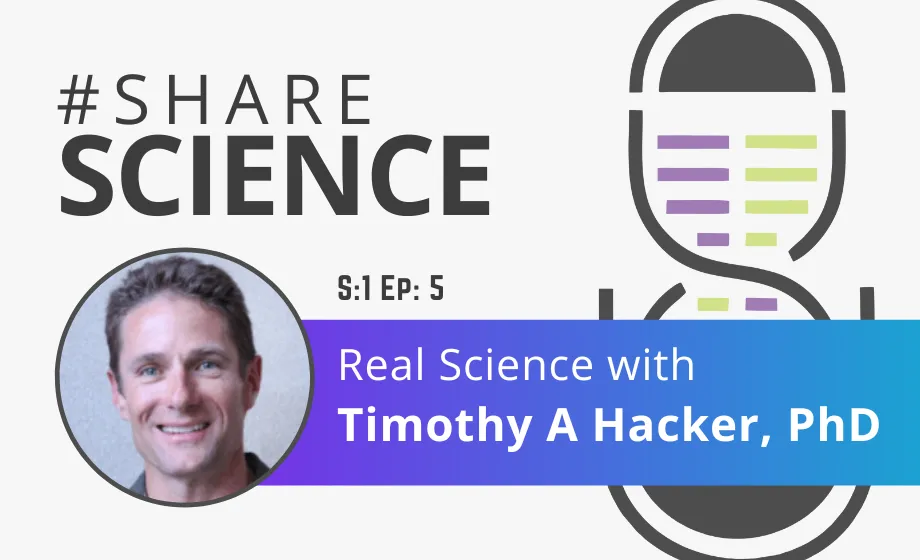
Talking Real Science with Tim Hacker This episode of #ShareScience features Tim Hacker , PhD, director of the Cardiovascular Physiology Core Facility at the University of Wisconsin-Madison. Throughout his career, Tim has established several cardiovascular disease models, including myocardial infarction, pulmonary hypertension, and myocardial stunning and hibernation models. He also shares his expertise with the world by developing microsurgery and imaging training programs for students and research professionals. In this interview, Tim shares his career path and insights for young scientists on what it's like to run a core lab at an academic institution. LISTEN TO THE PODCAST:
Where did you grow up and how did your youth influence your path and passion towards science?
I grew up in suburban Milwaukee, Wisconsin. I have really early memories of wanting to be an inventor. I remember going into the basement of my house and cutting blocks of wood and pounding them together in hope that they would do something. Mostly, I succeeded in not cutting myself or pounding my thumb with a hammer. In the fourth grade, we did some science experiments using bean seeds, and I was hooked. I thought it was the coolest thing ever, and I actually understood at that point (in a limited way) how science works, and it seemed really cool.
I had this, I think, innate curiosity about how things in the world around me worked and was fascinated by that.
Then I got busy and went through puberty and stuff like that and forgot about what else was going on. It dawned on me in high school that inventors and scientists are one in the same. Some of my dreams and passions came together at that point, but I still really had no clue how you could marry anything together or what a job like that would look like. That gets me to college, where I had a really strong interest in biology and how the human body works.
Where did you study and how did you end up in regenerative medicine and cardiovascular science?
I did my undergraduate and graduate work at the University of Wisconsin-Madison. As an undergraduate student, I messed around in the biological sciences, still not really knowing what I wanted to do. At some point, I took a biochemistry class and everything clicked for me there.
I love the pathways of biochemistry, and it really dawned on me that if you understood what's happening at the subcellular level, you can really understand what's happening in a whole body organism.
I was really starting to have a strong interest in human performance. What makes someone click? What makes someone a better athlete? How can you push those ideas to your advantage?
Is there any one person who was or is the greatest influence on your career?
Probably my parents, to some extent, because I think they did a really good job of developing a curiosity in us and having us think critically about things. They helped us ask these questions and never limited us in any way. In a more professional world, my first advisor when I started my master's degree was Dr. Bill Stanley. He was a crazy cat, basically. He was an amazing guy. He was really fun and he was unbelievably encouraging to me. I never really thought of myself as someone that is smart enough to get a PhD; I continued on scholastically for other reasons that we could talk about later. I think he understood me, and I understood him. He had this great work-life balance. He wasn't what I would consider a typical scientist, but he really was very practical. He knew when to dive deep into a subject, and when to let off and start doing experiments and make mistakes. It was really fun to watch him in progress and to understand how science really works. My vision of it was quite a bit different from what we did in his lab, in the experiments that we did and the way we tried things. Truthfully, he was fun. He was really a funny guy, and he did have his passion. He had, again, this big curiosity. He wanted to know something about everything and how things work. It was a beautiful marriage, basically, between him and I. He encouraged me to keep going and keep thinking and keep doing these things, and so it made it all really easy for me. [fusion_builder_column type="1_1" layout="1_1" align_self="auto" content_layout="column" align_content="flex-start" valign_content="flex-start" content_wrap="wrap" spacing="" center_content="no" column_tag="div" link="" target="_self" link_description="" min_height="" hide_on_mobile="small-visibility,medium-visibility,large-visibility" sticky_display="normal,sticky" class="" id="" type_medium="" type_small="" order_medium="0" order_small="0" dimension_spacing_medium="" dimension_spacing_small="" dimension_spacing="" dimension_margin_medium="" dimension_margin_small="" margin_top="" margin_bottom="" padding_medium="" padding_small="" padding_top="" padding_right="" padding_bottom="" padding_left="" hover_type="none" border_sizes="" border_color="" border_style="solid" border_radius="" box_shadow="no" dimension_box_shadow="" box_shadow_blur="0" box_shadow_spread="0" box_shadow_color="" box_shadow_style="" z_index_subgroup="regular" z_index="" z_index_hover="" overflow="" background_type="single" gradient_start_color="" gradient_end_color="" gradient_start_position="0" gradient_end_position="100" gradient_type="linear" radial_direction="center center" linear_angle="180" background_color="" background_image="" background_image_id="" lazy_load="avada" skip_lazy_load="" background_position="left top" backgro

Take the Next Step
Explore Suppliers
Browse trusted partners with relevant expertise
Review Capabilities
Compare services, experience, and past work
Start Your Project
Connect and begin collaborating
.png)

.jpg)



.png)
.avif)


.avif)