Adeno-associated virus (AAV) has become the workhorse for in vivo gene delivery due to its favorable safety profile, broad and engineerable tropism, and capacity for long-term expression in non-dividing cells (Wang et al. 2024). For researchers utilizing AAV, characterization of their AAV is essential for confirming vector quality, consistency, and experimental reliability. In gene delivery, the vector isn’t just a delivery vehicle, it’s the reagent that sets the ceiling on your entire experiment.
If the sequence is wrong, the titer off, the prep dirty, or the capsids aggregated, weeks to months can be spent optimizing experimental parameters that were never the root cause of poor performance. This is why it is critical to understand the quality controls that have been implemented during vector preparation.
It is also why Vector Biolabs are held to four baseline, critical specifications:
- >95% purity: little host-cell protein, residual DNA, or empty capsids left to confound results.
- High full-capsid ratio: viral preps with empty capsids can skew dose calculations.
- Low endotoxin: viral preps without low endotoxin can cause inflammatory responses, confounding results.
- Low incidence of double packaged capsids: genome titer is inflated by two genomes sharing one capsid.
Because manufacturers may apply different QC strategies, we use the FDA framework to assess gene therapy vector quality, organized around six critical quality attributes (CQAs): identity, purity, product strength, potency, safety, and stability (Figure 1) (U.S. Food and Drug Administration 2022). While not all researchers are performing gene therapy with their vector, this framework is a useful way to think about what “good QC” covers and where common failure points hide.
AAV Critical Quality Attributes
Identity confirms that the vector is what it is intended to be, including the correct transgene sequence, regulatory elements, serotype or capsid identity, and expected particle morphology.
Purity measures the absence or relative abundance of unwanted material, including empty or partial capsids, host cell proteins (HCP), residual host-cell or plasmid DNA, aggregates, non-AAV particles, and other process-related impurities.
Product strength defines how much vector is present (titer), such as vector genomes per milliliter, genome copies per milliliter, total capsids per milliliter, or full capsids per milliliter. Product strength supports dosing, lot comparison, and experimental reproducibility, but it should not be confused with potency.
Potency evaluates whether the vector performs its intended biological function, including transduction capacity, transgene expression, and functional activity. Unlike physical titer, potency requires a relevant biological assay.
Safety confirms that the vector preparation is suitable for its intended use and is free from critical biological contaminants or confounders, including endotoxin, adventitious agents, sterility failures, and replication-competent AAV.
Stability assesses whether the vector maintains its critical quality attributes over time under defined storage, handling, shipping, and freeze-thaw conditions.
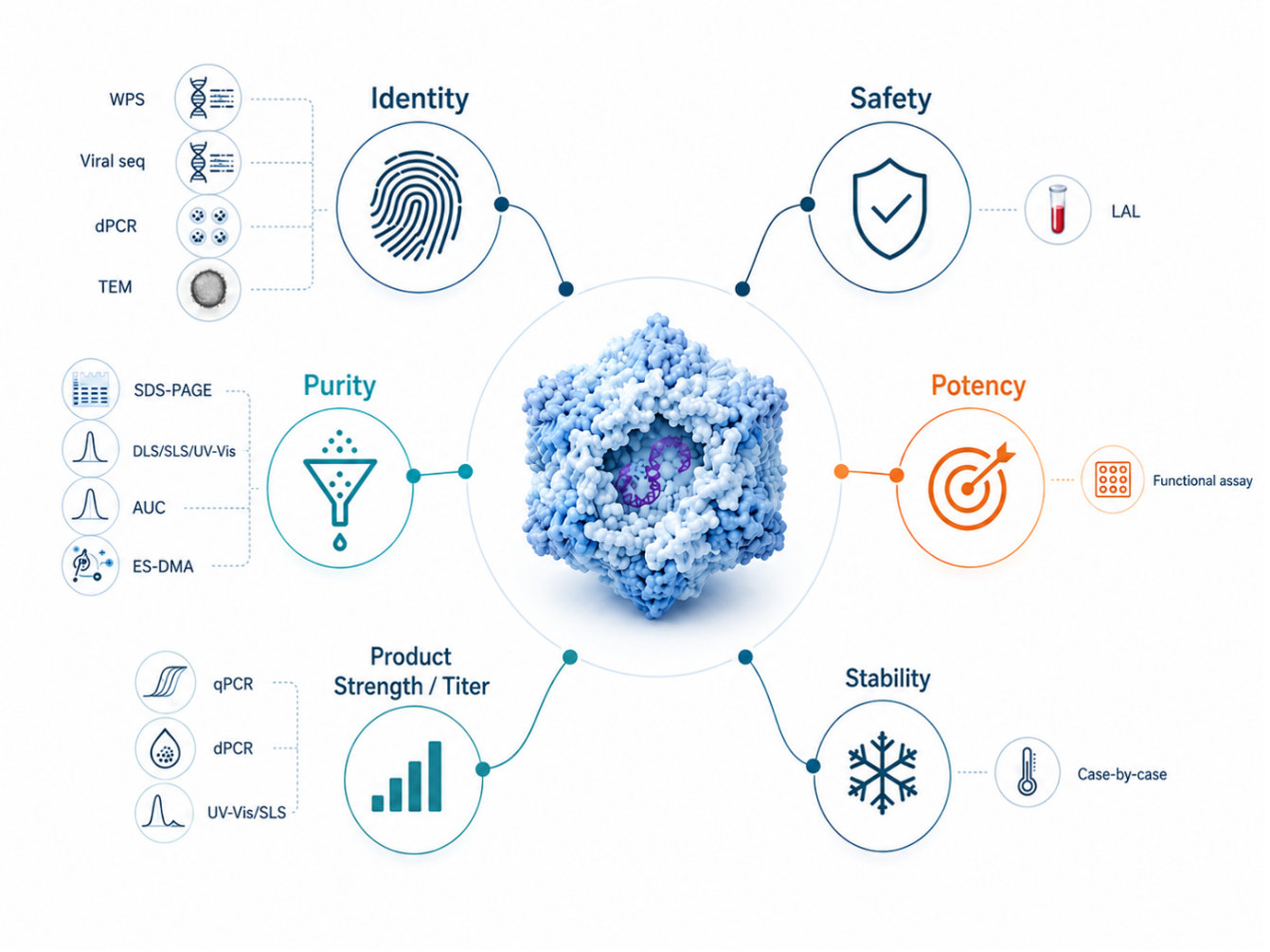
These six CQAs provide the framework, but no single assay can establish AAV quality across all of them. In practice, AAV characterization therefore combines complementary analytical methods, with each method contributing evidence for one or more attributes. For research-grade AAV, standard QC primarily addresses identity, product strength, purity, and particle quality, while safety, potency, stability, and higher-resolution characterization may require additional or study-specific assays.
Foundational AAV QC Analytics
For research-grade AAV, a foundational QC package can address several of the most immediate quality questions before downstream studies begin. Whole-plasmid sequencing confirms the sequence accuracy, plasmid integrity, and construct identity Accurate dosing is supported by qPCR through genome titer, Stunner analysis provides particle-size, aggregation, and optical capsid-content information, and SDS-PAGE/silver stain assesses capsid protein purity (Gimpel et al. 2021; Kontogiannis et al. 2024). Taken together, these methods provide a first-line quality screen that can address the most common vector failures prior to initiating downstream biological studies.
- Whole-plasmid sequencing: Confirms the entire transfer plasmid sequence, including promoter, transgene coding sequence, junctions, regulatory elements, and the regions flanking the ITRs.
- qPCR titer: Delivers the standard vector genome titer used for dosing.
- DLS / SLS / UV-Vis: Assesses particle size, aggregation, concentration, and optical capsid-content characteristics in one combined read.
- SDS-PAGE / silver stain: Verifies capsid protein purity and VP1:VP2:VP3 ratio.
Recent AAV characterization reviews emphasize that no single quality control method is sufficient to characterize all relevant AAV quality attributes or failure modes. Orthogonal methods are often needed to resolve questions like empty/partial/full capsid distributions or genome heterogeneity (Gimpel et al. 2021; Kontogiannis et al. 2024, Werle et al. 2021).
Advanced AAV QC Analytics
In addition to the standard QC package, advanced characterization methods are available for programs that require higher-resolution or orthogonal evidence. These methods include transmission electron microscopy (TEM), analytical ultracentrifugation (AUC), Limulus Amebocyte Lysate (LAL) endotoxin quantification, and digital PCR. They provide direct structural imaging, absolute quantification, or higher-resolution particle and genome characterization.
- TEM: Directly visualizes particle morphology and aggregation.
- AUC: Quantifies empty, partial, and full capsid populations at high resolution.
- LAL endotoxin: Quantifies endotoxin, an important inflammatory confound for in vivo and immune-sensitive studies.
- Digital PCR (dPCR): Provides standard-curve-free absolute titer and can be extended to assess genome integrity.
Advanced characterization can resolve failure modes that standard QC may flag indirectly but cannot fully explain. No single analytical method tells the whole story; the value comes from combining complementary measurements.
Summary
Reliable AAV experiments begin with a well-characterized vector. For research-grade AAV, the essential questions are whether the vector sequence is correct, whether the titer supports accurate dosing, whether the preparation is sufficiently pure, whether the particles are physically intact, and whether avoidable contaminants could confound the biology.
Vector Biolabs’ standard QC package addresses the most common early failure modes through whole-plasmid sequencing, qPCR titer, Stunner-based particle analysis, and SDS-PAGE/silver stain. This QC stack reflects our belief that a vector that can’t be characterized is a vector that can’t be trusted, and that research programs should not invest heavily in downstream biology built on a flawed vector.
For programs that require deeper characterization, additional methods such as dPCR, TEM, AUC, and LAL endotoxin testing provide higher resolution or orthogonal evidence. Together, these methods can resolve vector quality concerns that standard QC may flag but cannot fully explain.
For a closer look at standard and advanced AAV characterization methods, including what each technique measures, the failure modes it can uncover, and how the methods map to individual CQAs, download the full guide: [AAV Characterization: A Practical Guide to Standard and Advanced Quality Control LINK].
Explore AAV characterization services with our technical team.
References
U.S. Food and Drug Administration. Human gene therapy for neurodegenerative diseases: guidance for industry. Silver Spring (MD): U.S. Food and Drug Administration; 2022.
Gimpel AL, Katsikis G, Sha S, Maloney AJ, Hong MS, Nguyen TNT, Wolfrum J, Springs SL, Sinskey AJ, Manalis SR, Barone PW, Braatz RD. Analytical methods for process and product characterization of recombinant adeno-associated virus-based gene therapies. Mol Ther Methods Clin Dev. 2021 Feb 17;20:740-754.
Kontogiannis T, Braybrook J, McElroy C, Foy C, Whale AS, Quaglia M, Smales CM. Characterization of AAV vectors: a review of analytical techniques and critical quality attributes. Mol Ther Methods Clin Dev. 2024 Jul 30;32(3):101309.
Wang JH, Gessler DJ, Zhan W, Gallagher TL, Gao G. Adeno-associated virus as a delivery vector for gene therapy of human diseases. Signal Transduct Target Ther. 2024 Apr 3;9(1):78.
Werle AK, Powers TW, Zobel JF, Wappelhorst CN, Jarrold MF, Lyktey NA, Sloan CDK, Wolf AJ, Adams-Hall S, Baldus P, Runnels HA. Comparison of analytical techniques to quantitate the capsid content of adeno-associated viral vectors. Mol Ther Methods Clin Dev. 2021 Sep 1;23:254-262.

Take the Next Step
Explore Suppliers
Browse trusted partners with relevant expertise
Review Capabilities
Compare services, experience, and past work
Start Your Project
Connect and begin collaborating
Sponsor



.png)
.avif)




.avif)