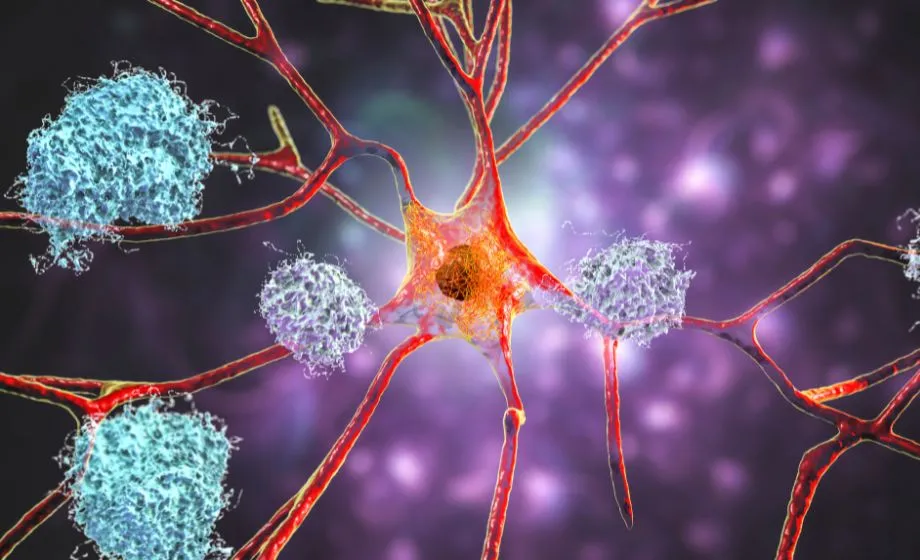
Alzheimer's Disease: Recent Research & Therapeutic Advances Scientific article by Nina Culum, MSc Alzheimers disease is a slow progressive neurodegenerative disease affecting an estimated 6.2 million Americans aged 65 and older in 2021 alone [1]. Although its prevalence increases with age, researchers stress that Alzheimers disease is not a normal part of aging. As the number of Americans aged 65 and older is projected to grow rapidly over the next few decades, Alzheimers disease prevalence is expected to increase as well. The projected increase in individuals living with Alzheimers disease is of great concern to researchers, particularly given the lack of a single diagnostic test during early disease stages and the fact that there is currently no cure. The Alzheimers brain is characterized by the presence of extraneuronal amyloid plaques and intraneuronal neurofibrillary tangles, which are both abnormal structures containing highly insoluble and densely packed filaments (Figure 1) [2]. Amyloid plaques are formed by the accumulation of beta-amyloid (A_) peptides, most notably containing 40 (A_40) and 42 (A_42) amino acids, while neurofibrillary tangles are composed of hyperphosphorylated tau proteins [3]. The accumulation of these plaques and tangles is accompanied by neuronal damage and coincides with symptom onset. Early symptoms of Alzheimers disease can include apathy and depression, while impaired communication, confusion, poor judgment, and behavioral changes are commonly reported at later stages of disease [1]. https://insidescientific.com/wp-content/uploads/2022/06/AD-Article-Image.jpg
Figure 1: 3D illustration of amyloid plaques and neurofibrillary tangles.
While A_ is the most prominent target in pharmacological clinical trials, additional important features of Alzheimers disease include neuroinflammation, mitochondrial dysfunction, endoplasmic reticulum stress, and abnormal calcium influx [4]. A major genetic risk factor for Alzheimers disease is the _4 allele of the apolipoprotein E gene (APOE _4). Individuals with APOE _4 are more likely to have A_ accumulation and Alzheimers disease at a younger age than those with APOE _2 or _3 [5].
Biomarkers of Alzheimer's Disease Pathology
No single diagnostic test currently exists for Alzheimer's disease. Standard Alzheimer's disease testing is based on a battery of tools and assessments, including structural imaging to rule out other conditions that may cause similar symptoms but require different treatments. The most widely used biomarker in clinical studies for Alzheimer's disease diagnosis is A_ measured in cerebrospinal fluid (CSF) and by positron emission tomography (PET) [3]. Alzheimer's disease CSF is characterized by an approximate 50% reduction in the concentration of A_42 [6], and increased diagnostic accuracy can be achieved by measuring CSF A_42/A_40 ratios. This ratio is nearly completely concordant with amyloid PET imaging, which has undergone extensive standardization [7]. However, CSF sampling is an invasive procedure, and amyloid PET is expensive, has limited availability, and is associated with a non-negligible radiation exposure [3]. Therefore, the identification and validation of blood biomarkers for A_ pathology would greatly improve diagnostics for patients with cognitive impairment. Plasma A_42/A_40 ratios have already been shown to reflect cerebral A_ pathology with high accuracy compared to amyloid PET and CSF A_42/A_40 ratios [8]. PrecivityAD is the first approved blood test designed to aid in Alzheimer's disease detection decades before symptom onset. This method quantifies plasma A_ and APOE levels by liquid chromatography with tandem mass spectrometry [9]. The results, which also account for a patients age, provide a probability score of a patient having an amyloid-positive brain scan. CSF tau may also be regarded as a predictive marker of Alzheimer's disease-type neurodegeneration [3]. Standardization work for tau imaging is still ongoing, but it could become a valuable tool for evaluating the efficacy of amyloid, tau, or combination therapy. Furthermore, tau PET has demonstrated the ability to detect the pharmacodynamic effects of disease-modifying drugs targeting both A_ and tau pathology [10]. [fusion_builder_column_inner type="1_3" layout="1_3" align_self="flex-start" content_layout="column" align_content="flex-start" valign_content="flex-start" content_wrap="wrap" spacing="" center_content="no" column_tag="div" link="" target="_self" link_description="" min_height="" hide_on_mobile="small-visibility,medium-visibility,large-visibility" sticky_display="normal,sticky" class="" id="" background_image_id="" type_medium="" type_small="" order_medium="0" order_small="0" spacing_left_medium="" spacing_right_medium="" spacing_left

Take the Next Step
Explore Suppliers
Browse trusted partners with relevant expertise
Review Capabilities
Compare services, experience, and past work
Start Your Project
Connect and begin collaborating
Sponsor

Harvard Bioscience, Inc.

.png)

.jpg)





.png)
.avif)





.avif)