The concept of precision (or personalized) medicine is not new. Arguably the first example of personalized medicine was the implementation of anticoagulation clinics in the early 1960s to support the administration of Warfarin1. This shift was due to the drug's narrow therapeutic window and risk of bleeding or clotting, which required specialized clinics to be developed to monitor prothrombin time (PT) and later INR on a regular basis. This was the first example of a formal infrastructure for what we would now call phenotype-based personalized care.
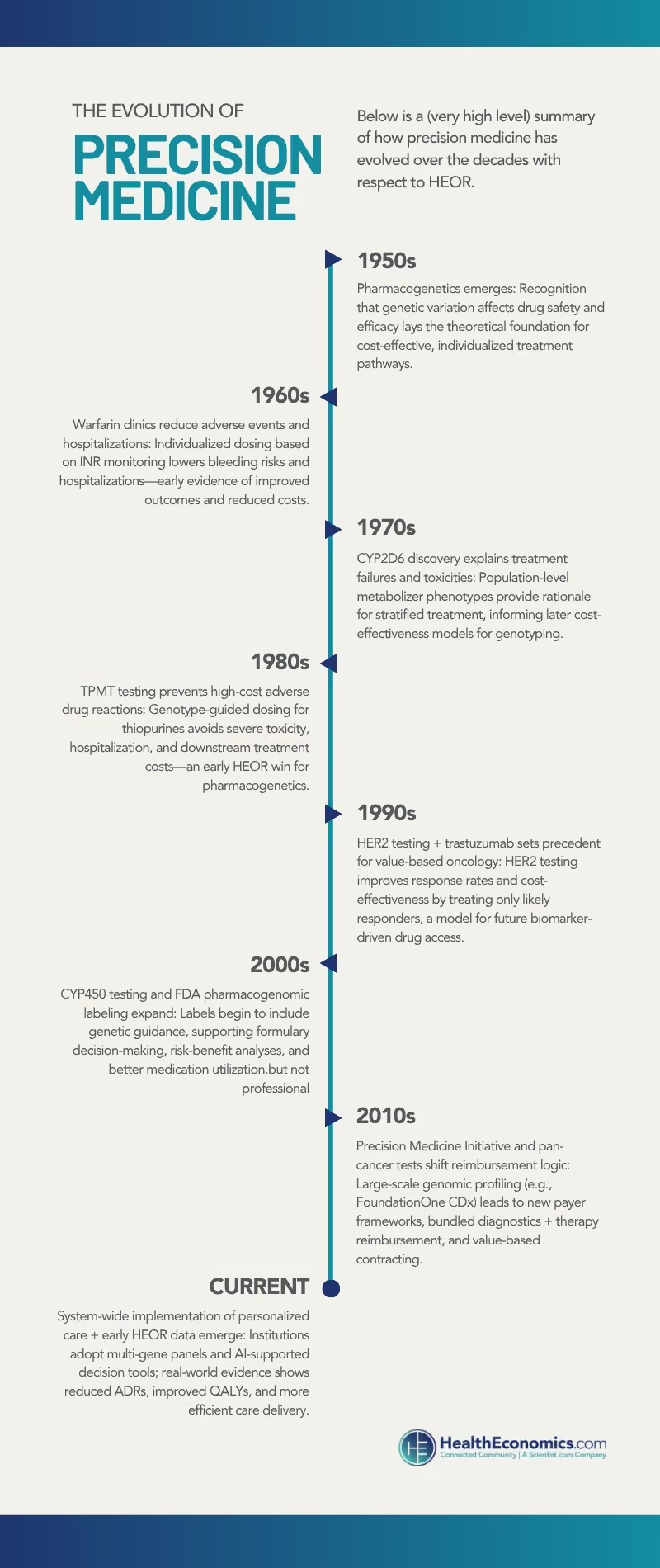
The approach of tailoring treatment and disease prevention to the right drug, right patient at the right time is becoming more prevalent and more accessible than ever before.
Targeted Therapies in the Real World
With smaller cohorts, targeted populations, the involvement of companion diagnostics, and limited clinical trial data being generated, precision medicine strains traditional cost effectiveness models despite its potential for truly positive outcomes. The value of these medicines are proven. Take for example Herceptin, (trastuzumab)—a monoclonal antibody developed by Genentech; the return on investment can be viewed from two angles: that of the pharmaceutical company and that of the payers.
It is important to note that back in the late 1990s this approach was novel. Prior to launch a number of uncertainties existed due to how the drug was developed as well as its target patient population. These unknowns included:
- High Scientific and Clinical Risk
- Herceptin was among the first targeted cancer therapies based on a biomarker (HER2 overexpression), which was a novel approach at the time, and many questioned whether it would work.
- HER2-positive breast cancer was known to be aggressive, and the idea of narrowing a drug’s use to a subset of patients (only ~20–25% of breast cancer patients) seemed commercially risky.
- Limited Precedent for Precision Medicine
- There was no strong precedent for precision oncology. Investors and companies worried that biomarker stratification would reduce market size too much to be profitable.
- It was unclear how regulators and payers would respond to a drug targeting a small segment of patients.
- High Development Costs
- The development of monoclonal antibodies was more expensive than small molecules.
- Manufacturing complexity and the need for companion diagnostics added to cost and time investment.
- Payer Skepticism
- Before strong outcome data became available, payers were concerned about the high cost of biologics like Herceptin.
- Cost-effectiveness was unproven pre-launch; initial payer access was uncertain in some markets.
Looking back now, the lifecycle of Herceptin was a huge success for both pharmaceutical companies and payers. Over time, Herceptin demonstrated such clear benefit that it redefined the standard of care, solidifying its commercial success. From a payer perspective this new approach enabled them to justify the high cost due to the clear clinical value as it was more cost-effective per Quality-Adjusted Life Year (QALY) than traditional chemotherapy.
The success of Herceptin and other personalized medicines cemented the clinical value of this new strategy of personalised healthcare. However, in order to evaluate the true long-term value, impact and real world effects, a new approach is required to review outcomes and access and ultimately decide how valuable, or not, a potential treatment could be.
Built on long-term modeling, rich data sets, and population averages, the traditional health economics and outcomes research (HEOR) tools are out of their depth with modern innovations in medicine. So, how can we prove value for these small populations, limited data, and individualized therapies?
When N = 1
When evaluating purely from the perspective of high upfront cost and limited data, even if efficacy is high for the right patients (more often the case for rare disease and some cancers), it can still be challenging to justify. QALYs and other standard cost-effectiveness models face significant limitations in fully and fairly capturing value and ROI. While they remain foundational tools, their structure is not inherently suited for the complexity, nuance, and heterogeneity of personalized treatments.
Payers and stakeholders need reassurance that the therapies are truly beneficial and that the evidence will hold up once the clinical trials are over. Bringing in new evolving frameworks into the HEOR modeling,such as stratified cost effectiveness models, patient-reported outcomes (PROs), and multi-criteria decision analysis (MCDA), and starting this earlier in the drug development pipeline could be the answer. By beginning with outcomes planning and economic modelling, early researchers can:
- Overcome short-term/limited data by projecting long-term impact.
- Better appreciate possible tradeoffs in testing, dosing, and administration routes,
- Anticipate stakeholder questions about budget impact, barriers to access, and subpopulation use.
Post-launch, critical real world evidence (RWE) can help fill the gaps left by limited trial data, while also supporting and adding colour to cost offsets, resource use, and how the results could be generalized across patient populations and subgroups. We have seen this in action with pembrolizumab (Keytruda) and tumor-agnostic therapies. RWE was a cornerstone in developing the case for treatment persistence and the impact on health systems for various tumour types. The ability to link genomic data to long-term health records was a compelling case for how the treatments would perform in the real world.
Innovation and evolution to our current definition of evaluating and demonstrating value is non-negotiable if we are to make the case for individualized therapies. It will become imperative that we look beyond population average, build and utilize better frameworks early, incorporate RWE early and often, and engage with all stakeholders to foster understanding and confidence. Precision medicine is no longer the future, it is the here and now. Now we need to adjust our way of evaluating and placing value and access quickly, ensuring precision all around.
References:
- Berrettini, M. (1997). Anticoagulation clinics: The Italian experience. Haematologica, 82(6), 713–717. https://haematologica.org/article/view/1021

Take the Next Step
Explore Suppliers
Browse trusted partners with relevant expertise
Review Capabilities
Compare services, experience, and past work
Start Your Project
Connect and begin collaborating
.png)

.jpg)






.png)
.avif)




.avif)