In our last post, we argued that AI is not replacing the scientific method. It is accelerating it.
So, what happens if we take that idea to its logical conclusion? If we were designing a drug discovery program from scratch today, what would it look like? We don't think it would look much like traditional R&D.
Today, discovery is still largely a series of disconnected steps. Scientists generate hypotheses, design experiments, find someone to perform them, wait for results, analyze the data and then decide what to do next. Information moves between people, departments and outside vendors through meetings, emails, spreadsheets, PDFs and databases.
AI agents change what an organization actually has to manage. As agents take on more of the work itself, the organization moves up a level of abstraction. It stops worrying about each individual task and starts worrying about the loops that work runs through, and the systems that give agents what they need to run them. That comes down to two things: capabilities, the tools that let an agent actually do something, and outcomes, the data that tell it what happened. In science, doing means running experiments, and outcomes are their results.
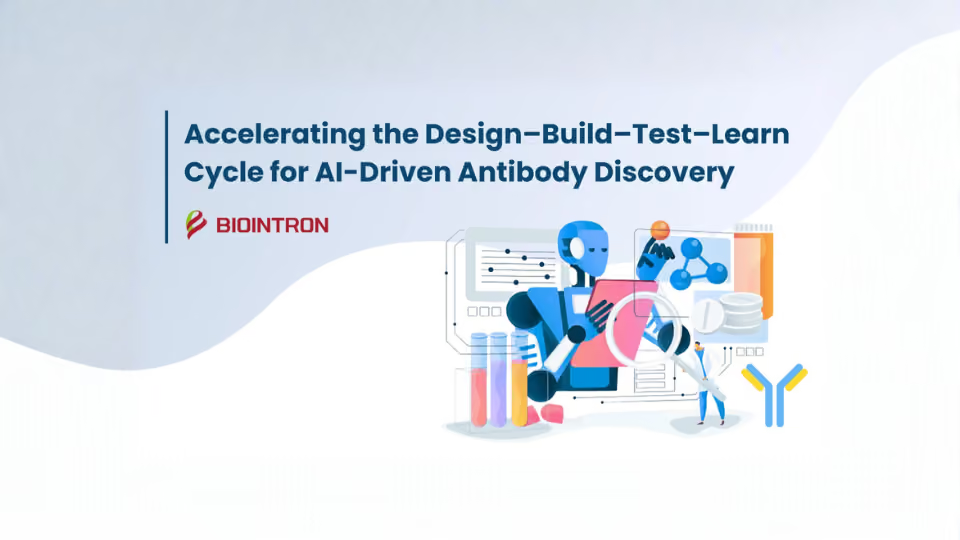
An AI-native drug discovery program would be designed around a continuous, self-improving loop that connects both:
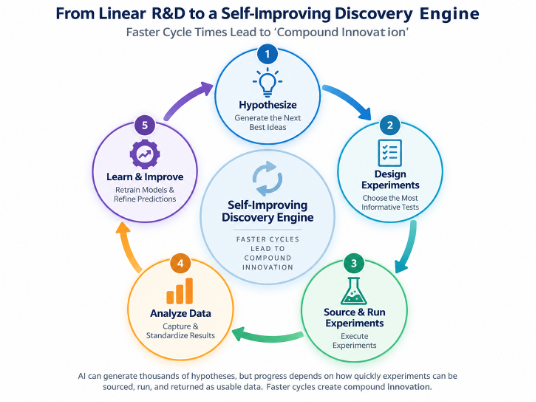
From a pipeline to a learning engine
AI will soon be able to generate far more plausible hypotheses than we could ever test. That means the important question is no longer simply, What might work? It becomes: What is the most informative experiment we can run next?
AI can help answer that question by selecting the right conditions, controls, technologies and approaches based on everything already known. But ultimately, those ideas still have to be tested in the real world. Until AI can reliably predict the results of biological experiments, progress will depend on how quickly the right experiments can be executed and the data returned.
This is where the physical world becomes the bottleneck. An AI can generate a thousand hypotheses in seconds, but if it takes six weeks to find the right laboratory, get a quote, complete compliance reviews, ship samples, perform the work and receive the data, the discovery program is still moving at six-week speed.
A recent example from Anthropic makes the point. Its AI agents searched a large DNA sequence database and, in about 21 hours, narrowed roughly 200,000 reverse transcriptases down to 20 candidates, surfacing a previously uncharacterized enzyme system. The computational side moved at machine speed. Confirming what the system actually does still required scientists running experiments in a wet lab.
In an AI-native system, scientific intent should flow directly into execution. This is the capabilities side of the loop: the agent needs tools that let it act in the physical world, not just reason about it. The system identifies the right technology or provider, handles procurement and compliance, initiates the experiment and tracks it through completion. Whether the work happens internally, at a CRO, in an academic lab or in an automated laboratory matters less than one thing:
How quickly can we run the right experiment and get high-quality data back?
Every experiment should improve the next one
The other side of the loop is outcomes, and the data coming back also need to change. Today, results are often delivered in formats designed primarily for people: reports, PDFs, PowerPoints and spreadsheets. An AI-native discovery engine needs results that are structured and contextualized: what was done, how it was done, under what conditions, using which samples, reagents and protocols.
The experiment should return not just a result, but machine-usable knowledge. That knowledge updates the models, changes what the system believes and helps determine the most informative experiment to run next.
And then the loop starts again.
This is where something more powerful than simple efficiency begins to emerge. Faster cycles produce more experiments. More experiments produce more data. Better data improve the models. Better models help select better experiments, which in turn generate more useful data.
We think of this as compound innovation.
Each cycle does two things: it generates new knowledge, and it improves the system's ability to generate knowledge in the next cycle. The better the system becomes at choosing and executing experiments, the more valuable each subsequent cycle can become.
The advantage therefore doesn't just accumulate. It compounds.
The fastest learning loop wins
This may ultimately matter more than having the best AI model.
Models are improving incredibly quickly and will increasingly become widely available. A more durable competitive advantage may be the system surrounding the model: the tools that let it act, the data that flow back to it, and the ability to continuously turn hypotheses into experiments, experiments into high-quality data, and that data into better hypotheses.
Who can generate the best hypotheses?
Who can identify the most informative experiment?
Who can get that experiment running fastest?
Who can return high-quality, standardized data to the models fastest?
And who can turn those results into the next experiment fastest?
A company that completes this loop faster doesn't simply conduct more experiments. It learns sooner, improves sooner and begins the next cycle from a better starting point. Over time, those advantages can build on one another.
Scientists remain essential. They set objectives, recognize surprising results, make connections and decide which problems are worth solving. But increasingly, they will work one level up. Rather than managing each step, they will design and improve the loop itself, and direct a system capable of generating hypotheses, coordinating experiments, analyzing results and continuously learning from what happens.
The AI-native drug discovery program of the future is therefore not simply an AI that predicts drugs. It is a self-improving discovery engine that connects intelligence directly to experimentation, and experimentation directly back to intelligence.
The ultimate competitive advantage may be surprisingly simple: Build the fastest learning loop and let compound innovation do the rest.

Take the Next Step
Explore Suppliers
Browse trusted partners with relevant expertise
Review Capabilities
Compare services, experience, and past work
Start Your Project
Connect and begin collaborating
.png)
.avif)



.avif)