Slingshot Biosciences develops precision-engineered cell mimics™ that replace biological and bead-based controls in cell-based assays. Our SpectraComp® and TruCytes™ solutions empower labs to improve assay accuracy, reproducibility and standardization across research, drug development and cell therapy workflows while reducing time and costs by an average of 88%.
1. What are precision-engineered cell mimics™, and why do they matter for flow cytometry?
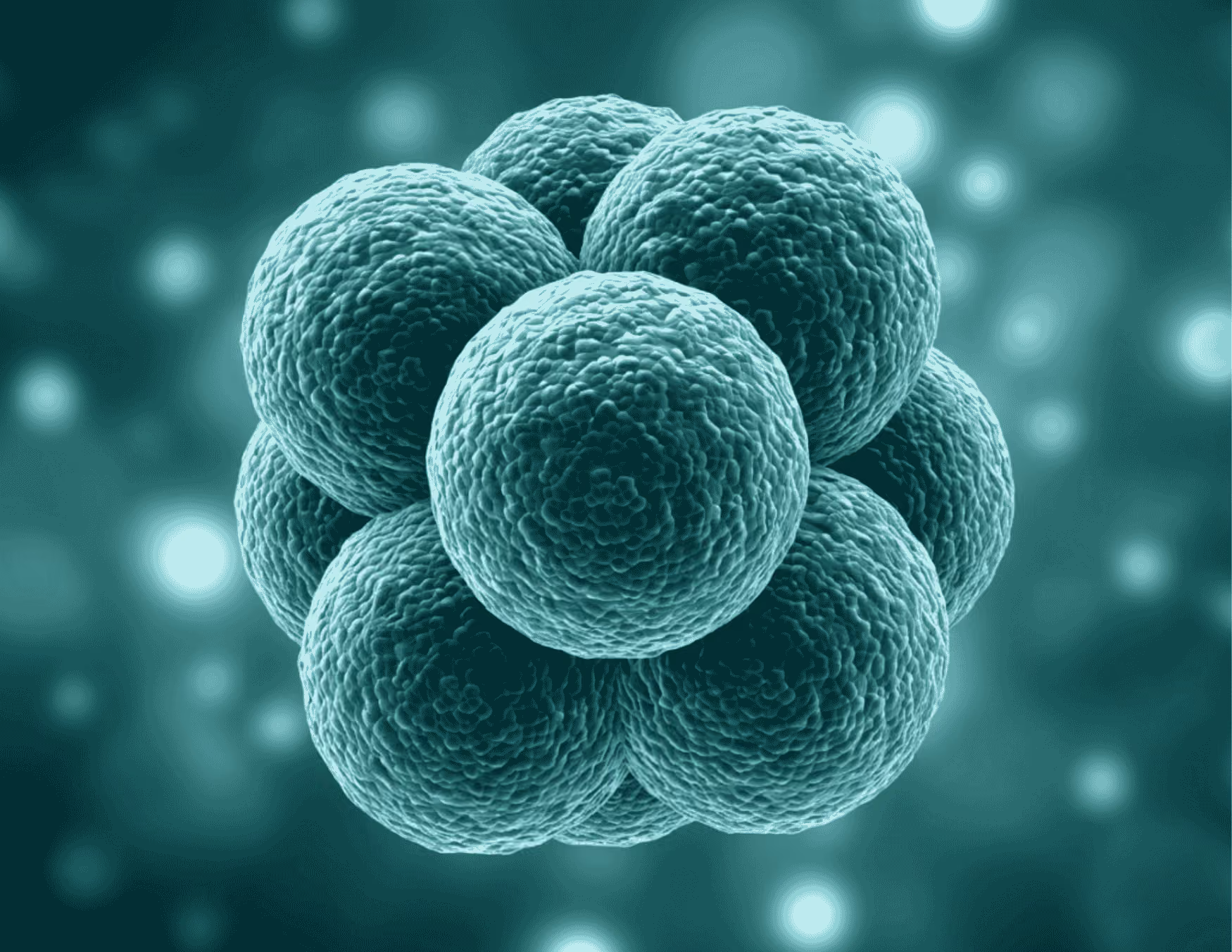
Precision-engineered cell mimics™ are advanced synthetic controls that optically resemble real cells at the instrument level. Unlike traditional polystyrene beads or donor-derived cells, they are manufactured from proprietary polymer materials to match key cellular properties:
Forward and Side Scatter: Accurately replicating cell size and granularity.
Autofluorescence: Closely mimics the natural background fluorescence of specific cell types.
Biomarker Expression: Presenting surface or intracellular antigens with precise density.
By replacing variable biological controls with consistent, manufactured mimics, labs can achieve higher reproducibility and eliminate the logistical headaches of fresh or frozen samples.
2. How do they compare to biological controls?
Every control type has trade-offs, but precision-engineered cell mimics™ bridge the gap between stability, reproducibility and biological relevance.
Donor cells (e.g., leukopaks, healthy donors): Cycles of sourcing donors, rare biomarkers and material that suffer from high variability requiring frequent QC bridging studies and a short shelf life.
Cell lines: Time consuming cycles of developing and maintaining cell lines that suffer phenotypic drift, contamination and endless QC bridging studies.
Cell mimics: Cell mimics offer superior reproducibility and stability that significantly reduce the need for QC bridging studies.
3. What is the difference between SpectraComp® and TruCytes™?
While both use our core mimic technology, they solve different problems in the flow cytometry workflow :
SpectraComp®: Off the shelf Fc binding controls for use in compensation and spectral unmixing.
TruCytes™: Biomarker-defined reference controls . Mimic specific phenotypes (e.g., CD4+ T cells) and are used for assay verification, gating, longitudinal data consistency and quality control (QC) .
4. How do SpectraComp® controls improve high-parameter spectral flow?
In spectral flow cytometry , accurate unmixing relies on following the 4 basic rules for single stained controls as outlined below:
Fluorescence spectrum of your single stained control and multicolor must match.
Autofluorescence of your negative and positive particles must match.
Single stained control must be as bright or brighter than your multicolor.
You must collect enough positive events.
SpectraComp® controls:
Offer multiple host species compatibility , such as mouse, rat, hamster as well as rabbit and human in the XT version.
Reproduce similar cellular autofluorescence for more accurate unmixing.
Stain as bright or brighter than cells, while ensuring enough positive events are collected to comply with rules #3 and #4.
5. Can TruCytes™ really mimic cell specific phenotypes?
Yes. TruCytes™ are versatile, biomarker-defined controls that can represent a wide range of biologically relevant targets, including:
Immune Subsets: T cells, B cells, NK cells and monocytes.
Oncology Targets: Tumor markers like EGFR and PD-L1 .
Cell Therapy Markers: CAR detection and activation markers like Ki-67 .
6. How customizable are these controls for my assay?
One of the most significant advantages is configurability . We can tailor TruCytes™ to your exact specifications:
Marker Selection: Choose your specific surface or intracellular targets.
Antigen Density: Tune expression levels (dim, mid, bright) to match your clinical or research samples.
Optical Profile: Adjust scatter to mimic specific cell populations (e.g., lymphocytes vs. granulocytes).
7. Do I need to change my workflow to use them?
No. Precision-engineered cell mimics™ are designed to drop directly into existing workflows .
Compatible with buffers: Proven to work with standard flow reagents such as lysis, fixation and fix/perm buffers.
Standard Staining: Use your existing antibody panels and protocols.
Same Acquisition: Run them precisely as you would a cell-based control.
8. How stable and reproducible are they?
Stability and reproducibility are key benefits.
Stability: Unlike primary cells that degrade in hours or days, our mimics are shelf-stable for months or years (check specific product labels). They typically store at standard refrigeration (2-8°C) for non-biomarker controls or frozen (-20°C) for TruCytes™ products, eliminating the need for liquid nitrogen and complex cold-chain logistics.
Reproducibility: Our mimics demonstrate lot-to-lot consistency of <10% CVs across 11 lots and significantly improve reliability in head-to-head comparisons to donor-derived controls.
9. Are these suitable for regulated or cell therapy environments?
Yes, they are widely used in assay development, manufacturing support and QC for cell therapies. They are for Research Use Only (RUO) and are manufactured in our ISO 9001 certified labs. Their accuracy and consistency make them excellent tools for:
System Suitability Testing (SST) .
Instrument Standardization across multiple sites.
Longitudinal QC to track assay drift over time.
10. How can I get started?
Most labs begin with a simple pilot:
For Panel -Set-up: Try SpectraComp® to improve your compensation or unmixing results.
For Assay QC: Replace a variable biological control with TruCytes™ mimics to improve reproducibility while reducing time and costs.
Ready for reproducible flow cytometry assays? Visit the Slingshot Biosciences profile on Scientist.com to browse our SpectraComp® and TruCytes™ offerings or contact us to discuss a custom control for your unique application. Connect with Slingshot Biosciences on Scientist.com
Learn more: slingshotbio.com

Take the Next Step
Explore Suppliers
Browse trusted partners with relevant expertise
Review Capabilities
Compare services, experience, and past work
Start Your Project
Connect and begin collaborating
Sponsor

.jpg)





.png)
.avif)


.avif)