For patients living with myasthenia gravis (MG), a chronic autoimmune neuromuscular disease, the daily reality of the disease is rarely captured by insurance claims. It lives in the language of a physician's notes: descriptions of how a patient is struggling to lift their arms, swallow, or simply get through the day. For years, that information has been effectively invisible in claims data. AI is changing that.
Our latest research, to be presented at ISPOR Europe 2026, demonstrates how large language model (LLM)-based extraction, combined with clinician review, can pull validated patient-reported outcome scores directly from unstructured clinical notes and use them to track how disease progresses over time, at scale.
The Problem With "Standard" RWD
Measuring MG’s burden on patients relies heavily on the MG-ADL scale, a questionnaire that captures how the disease affects activities of daily living, from eating and breathing to vision and mobility.
The challenge is that these scores do not show up in claims data. Instead, they are often documented in physician notes, neurology consults, and visit summaries, making them difficult to capture through traditional claims-based RWD approaches.
Claims data can identify diagnoses and healthcare utilization, but it rarely captures how a patient is actually functioning. Measures of symptom severity, mobility, cognition, or other aspects of patient function are more likely to appear in clinical notes than in claims. LLM-based extraction makes it possible to systematically identify these details and track how a patient’s function changes over time.
Scale Is the Game Changer
Historically, capturing this type of information required manual chart review. While valuable, chart review is time-intensive and difficult to scale, often limiting analyses to a few hundred patients and making it challenging to understand patterns across larger populations.
Using LLMs to extract scores from clinical notes, this study analyzed thousands of patient records, expanding the analysis well beyond what is typically feasible with manual chart review. That scale makes it possible to examine patient trajectories across a much broader population and identify patterns that may be difficult to see in smaller samples, generating more robust evidence for outcomes research in MG and neurological disease more broadly.
Closer to the Patient
What makes this research particularly compelling is what it actually measures: the patient experience, in the patient's own words, as documented through clinical care. This is putting the patient at the center because it's showing the real impact that disease has on their life. Claims data can tell you what treatments a patient received. Patient-reported functional outcomes tell you how a patient is actually doing and whether that's changing over time.
Broadening the Scope of What’s Possible
The study was built with NorstellaLinQ, a fully integrated data platform that connects real-world data with clinical, regulatory, payer, and commercial intelligence to provide a comprehensive view of the patient journey. NorstellaLinQ links claims data to clinical notes, a connection that serves as the foundation for this kind of multi-dimensional outcomes research. But the platform's potential extends well beyond this initial study.
Once patient function is captured longitudinally, researchers can begin asking deeper questions: How do MG-ADL scores correlate with lab data over time? Do some treatments lead to more functional improvements than others? How does disease progression impact healthcare utilization over time? NorstellaLinQ can broaden the scope of the study to objectives well beyond just changes in patient scores.
A Blueprint for Rare Disease Research
The implications extend well beyond MG. Across rare and neurological diseases, important measures of function and disease progression are often documented in clinical notes but remain difficult to use at scale. The approach demonstrated here, combining LLM-based extraction with human-in-the-loop validation, provides a scalable and repeatable way to turn that clinical documentation into usable evidence across disease areas where structured outcome measures are limited.
For researchers, this opens new opportunities to study disease progression, patient function, and outcomes in populations that have been difficult to characterize using traditional RWD alone. For clinicians, it can provide a more complete view of how a patient’s condition is changing over time, complementing diagnoses, treatments, and utilization data with information about function and symptoms. For life sciences teams, it creates new opportunities to understand unmet needs, characterize patient populations, and generate evidence around outcomes that are difficult to capture in claims alone. For health systems and payers, these insights can help connect clinical outcomes with patterns of care and healthcare utilization.
And for patients, it means that the details documented throughout their care can become part of the evidence used to understand their disease, rather than being left buried in the clinical record.
Find out how NorstellaLinQ can bring you closer to the patient than ever before. Contact us.

Take the Next Step
Explore Suppliers
Browse trusted partners with relevant expertise
Review Capabilities
Compare services, experience, and past work
Start Your Project
Connect and begin collaborating
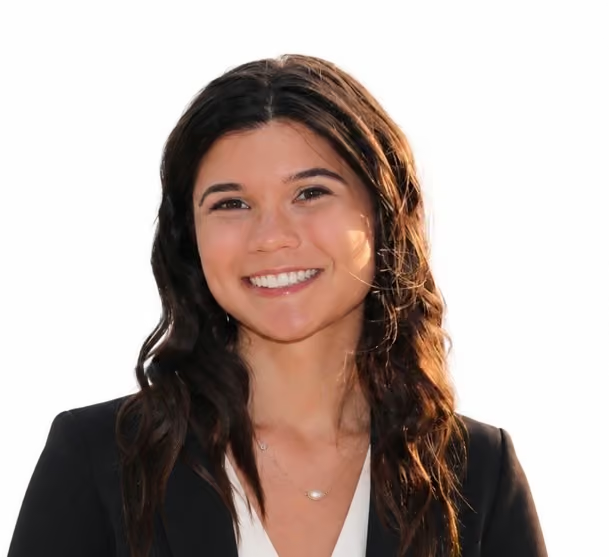
Becky Hollenberg, MPH, is a Senior Strategy Lead on the RWD Strategy and Innovation team at Norstella, where she partners with pharmaceutical and biotech organizations to leverage integrated real-world data and evidence to inform market access, HEOR, commercial, and clinical strategy. She specializes in translating complex business questions into actionable evidence generation approaches, helping clients uncover insights across the patient journey using integrated claims, EMR, lab, and clinical notes data. With a background in public health and healthcare analytics, Becky works closely with life sciences teams to design studies, identify evidence gaps, and generate data-driven insights that support market access decision-making and patient access to innovative therapies.
Sponsor
.png)


.png)
.avif)



.avif)