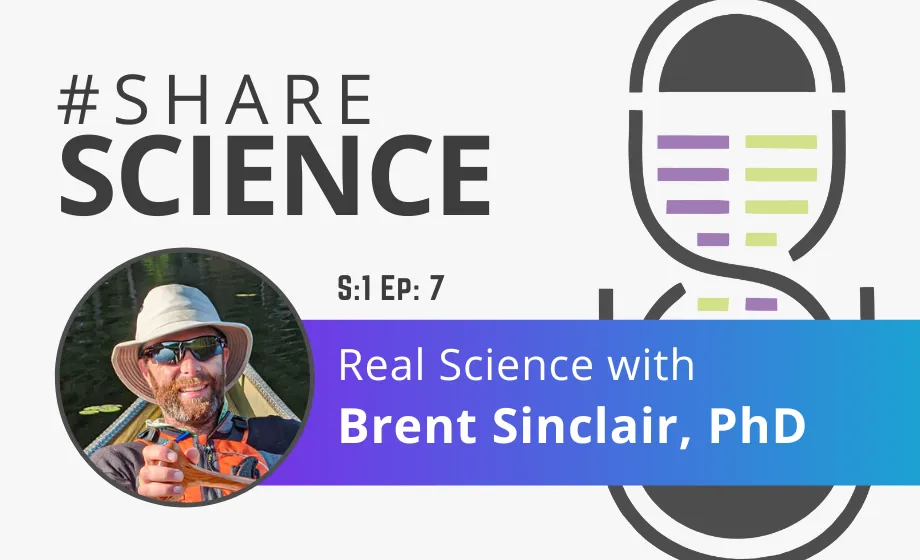
Talking Real Science with Brent Sinclair
Watch at: https://youtu.be/WrBQ_SFF8qg
This episode of Share Science features Brent Sinclair , PhD, a biology professor at Western University . Brent's research largely involves insect thermal biology and has seen him freezing bugs all over the world. Brent spends quite a bit of time outside of his research and teaching responsibilities organizing career events for graduate students in the biology department. In this interview, Brent shares why these opportunities are so important for graduate students as they get close to finishing their degrees, as well as his career path and passions in and out of the lab.
Where did you grow up and how did your youth influence your path and passion towards science?
I grew up in New Zealand, which is why I talk funny. I'm the first generation in my family to go to university and that sort of thing. I grew up in the North Shore of Auckland, which is about as exciting as growing up in Burlington near Toronto. What we had back then on prime time Saturday evening television was blue-chip nature documentaries, most of which were actually made in New Zealand. Strangely enough, the Natural History unit in Dunedin is the second largest producer of natural history documentaries in the world after the BBC. There were all these great things about the biology of New Zealand and surrounding areas, and that meant that when I got to university, I could really relate to where all these creatures were.
Where did you study and how did you end up in your current field?
I started out at university with this grand plan to do a double degree in English and biology. At the time, you had to do an entire degree in biology and also an entire degree in English, and almost no courses could be cross credited from one to another, which was going to take five years. Looking back, that could have been a monumentally stupid idea for me. This was at the University of Auckland. When I was between first and second year, I had this job banging lids on pots in a chemical factory. I was the guy that would weigh in 500 grams of pool chlorine when you would buy it in tubs and hammer it on with a rubber mallet. I was chatting to the other guy that was working with methrough respirators, of course. A lot of conversations were like this: I was talking about the difficulty of figuring out my schedule for the next year because all the biology courses had all these lab components and the English courses tended to be in the afternoons when the biology labs were. He was a couple of years ahead of me at university and asked, "What have your grades been like in these different things? I said, "Well, I do really well in biology because it's easy and not so well in English and philosophy because they're challenging and interesting." He asked, "Well, has it occurred to you that you might be good at biology and not as good at English and philosophy?"
This was a revelation, which probably tells you all sorts of things about my self-awareness. I went into full-time biology.
At the end of the year, I managed to get myself a research job for about six weeks. There were research studentships, but I wasn't successful in getting one of those for the summer. There was a guy that had taught a field course and I really wanted to do it, so I phoned him, back in the days when we telephoned, every week for the entire term until he found some money to employ me for six weeks to help out his various graduate students in the field over the first part of the summer. As that wound up, I had a job sticking barcodes onto books in the library. If you've ever wondered how all those barcodes got onto all those old books, it was people like me, which meant that I finished my summer with an incredible knowledge of the Dewey Decimal System. The problem was that the department was amalgamating zoology and botany, and the university was also shifting from a quarter system to a semester system. The third-year courses were just all weird and screwed up. Knowing what I know about undergrads now, I was probably misreading the whole thing, but it seemed to me that it was just impossible to do any of the courses I wanted to do. I talked to my supervisor, who said, "You could think about going somewhere else. Otago University is really good for zoology right now and could be a good place to go." I wrote a letter, as one did in those days, to the department chair with a photocopy of my transcript and said, "What would be my chances of doing zoology?" He wrote back and said, "I think you'd be an excellent student here."
I packed up and moved to the other end of the country to do zoology, where, by the way, the library used the Library of Congress system, so all my knowledge of the Dewey Decimal System was a complete waste of time.
I immediately wriggled my way into doing some volunteering for various graduate students and field work. As it turns out, that was a theme throughout my studies at Otago. Dunedin is the wildlife capital of New Zealand, and we would literally have afternoon undergraduate lab trips to see seal colonies and penguins and albatrosses. It was just a stunning place to study, and it meant that there were all these opportunities with people doing fieldwork nearby. I spent a bunch of time with Jenny Rock, who is now actually faculty at Otago, helping her catch lizards and measure body temperatures. I did some work for various people that were running around at night banding sea birds. I was also interested in working on insects, which is strange because I was a little bit scared of insects. When I was in third year, we had an environmental physiology class and we had a guest lecture by a guy called Bill Block who was a researcher at the British Antarctic Survey. He gave two guest lectures about insect cold tolerance and about the fact that there are insects that survive freezing and insects that avoid freezing. I was like, "That is what I want to do." I basically signed off on helping out with lizard endocrinology and went and visited the person in the lab closest to this, which conveniently had Bill visiting on sabbatical. That winter break, I read the entire literature of insect cold tolerance, which was easier in 1995 than it is now, finally got a summer studentship, and worked on insect malpighian tubule physiology, which we are still working on in my lab, and did an honors project which involved me running up and down in the mountains and catching cockroaches in the winter. Then I knew that I wanted to do a PhD. I knew I wanted to stay in this university environment and I looked around and I didn't really know about anywhere other than Otago and Auckland universities.
I liked the lab I was in and there was an opportunity to go to Antarctica. I was like, "Great, I'll stay here and do some fieldwork in Antarctica." That's how I ended up doing my PhD.
Who has influenced your career and how?
I don't have any one person or mentor or anything like that who has had a huge impact on direction. There have been people along the way that have been enormously helpful and supportive. There have been people that haven't been supportive, but have still been helpful. I think that over time, you adopt mentors and peers as you go depending on the situation you're in. I think for anyone, that list should change over time.
I had my various supervisors and advisors who were formally involved, but also I often had people that I would informally adopt.
When I was a grad student, I worked a lot with a guy called Robert Poulin, who's a Canadian parasitologist, absolute superstar. I wasn't doing parasitology, but we spent a lot of time talking about science and he mentored me a great deal, probably more than I realized. Also, Janice Lord, who is a botanist but an alpine ecologist. I spent a lot of time in the botany department because there were fun people, like Kath Dickinson, who really influenced my thinking. Also, Sir Alan Mark, who's the godfather of New Zealand alpine ecology. Of course, I moved on and ran into various other people, postdoc advisors and so forth and such like, and also just generic advisors that you latch onto at conferences and become friends with.
Now I have the pleasure of still having mentors of various sorts, but also having a group of peers that really help me situate my work and understand where we're at and talk about what we're doing science wise.

Take the Next Step
Explore Suppliers
Browse trusted partners with relevant expertise
Review Capabilities
Compare services, experience, and past work
Start Your Project
Connect and begin collaborating
.png)

.jpg)




.png)
.avif)


.avif)