Quantitative polymerase chain reaction ( q-PCR) or real-time PCR, is both a quantitative and a qualitative technique to detect and measure the initial amount of a DNA sequence in a sample.
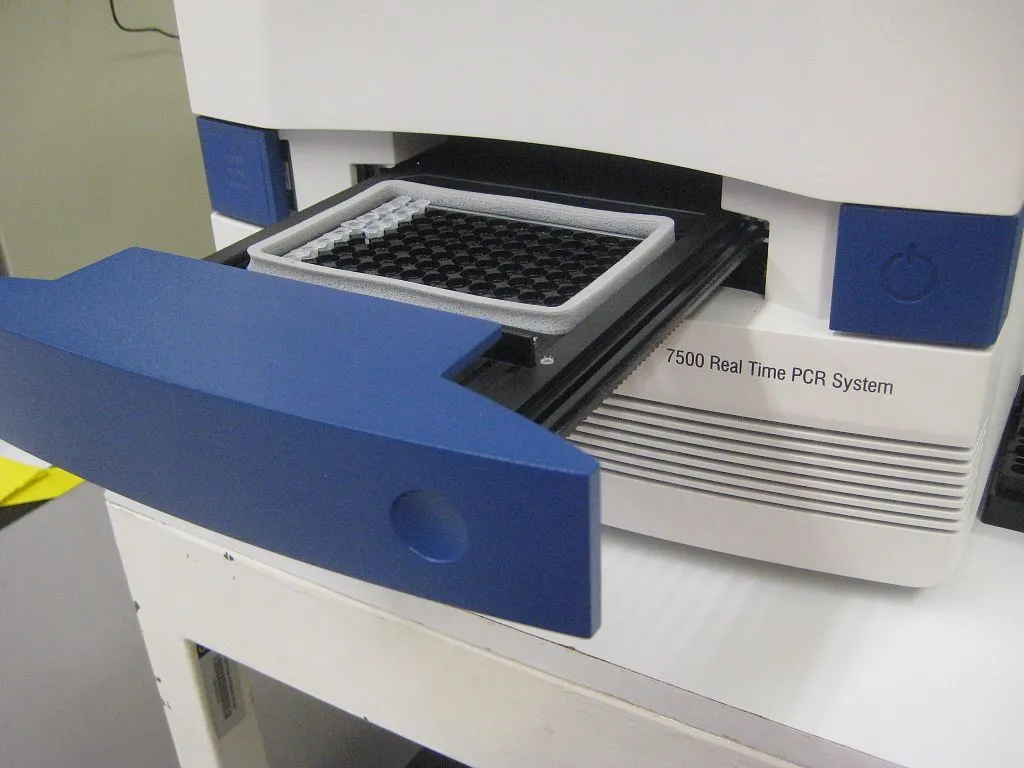
Applied Biosystems 7500 real-time PCR cycler, © Ca.garcia.s Wikimedia Commons
The technique is based on an enzymological reaction (DNA polymerase), and on the continuous measurement of its product. It enables, at each amplification cycle, to measure the total amount of DNA produced with a fluorescent marker. The experiment is carried out in a thermal cycler with the capacity to detect the fluorescence emitted by the excited fluorophore. Having the complete kinetics of the polymerization reaction makes possible to obtain absolute quantification of the initial quantity of target DNA sample. Thus, real-time PCR eliminates the need to use gel electrophoresis to detect the products and is a truly quantitative method.
Real-time PCR has numerous applications and is a tool of choice to determine and quantitate nucleic acids in different biological samples. In industry, qPCR is used in diverse fields: in the food industry to detect genetically modified organisms (GMO) in food and to quantitate the microbial load, to detect phytopathogens in the agricultural industry, and to quantitate and genotype human viral pathogens.
qPCR has become a popular technique in genomics for the quantification of gene expression. In association with reverse-transcription PCR (RT-PCR), qPCR assays can be applied to quantitate the changes in gene expression in response to environmental conditions or drug treatment for example.
It often takes time to find the CRO which corresponds to your qPCR needs. Here you can find a selection of services which can be useful for you.

Take the Next Step
Explore Suppliers
Browse trusted partners with relevant expertise
Review Capabilities
Compare services, experience, and past work
Start Your Project
Connect and begin collaborating
.png)

.jpg)






.png)
.avif)





.avif)